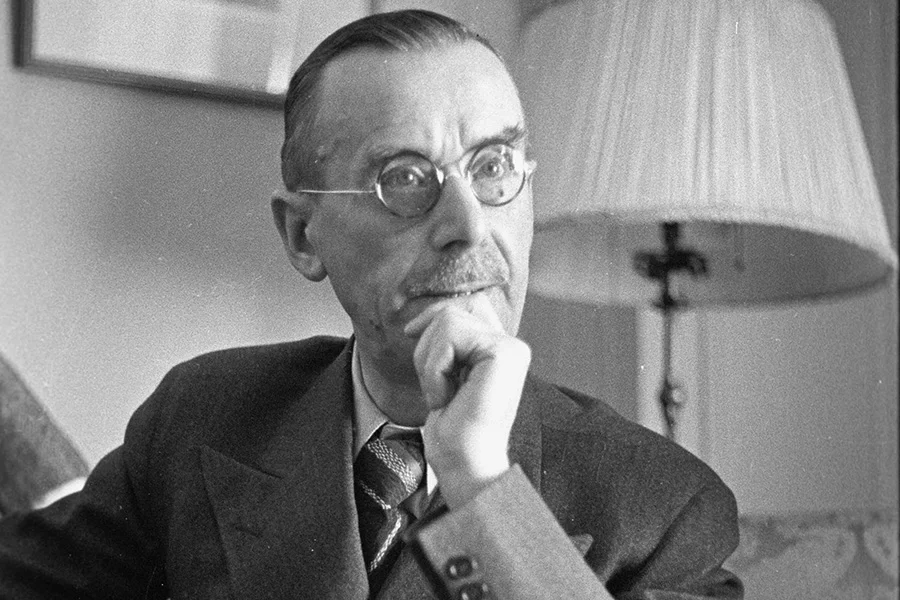
Thomas Mann ca. 1925–1945. Photograph by the Los Angeles Daily News. Courtesy of the UCLA Charles E. Young Research Library Department of Special Collections.
Colm Tóibín has spent three decades circling Thomas Mann and his family. He first read Buddenbrooks as a teenager, was handed three weighty Mann biographies to review for the London Review of Books in 1996, and has returned to the subject in essays ever since. The result is The Magician, his 2021 novel that moves through Mann's childhood in Lübeck, his years in Munich and Italy, his Nobel fame, his wartime exile in France and the United States, and his death in Switzerland at eighty. Tóibín's Mann is a patriarch who drifts through his own life with an almost impassive calm, withdrawing into his work whenever the household gets loud. His children have a nickname for him: Der Zauberer, the magician. He makes things appear out of thin air, and he rarely explains how.
That same restraint runs through Paweł Pawlikowski's Fatherland, which premiered at Cannes this year. Hanns Zischler plays Mann and Sandra Hüller plays his daughter Erika, and the two travel back to a divided Germany to accept the Goethe Prize. The film began as an adaptation of The Magician, but Pawlikowski's script bends the novel and the historical record in places. Most notably, Katia, who barely appears on screen, is the one who made the trip, while Erika refused to go. Tóibín is thanked in the credits and insists there is "not a line" of his dialogue in the film. Still, certain phrasings sound familiar, along with the tone: deadpan, a little cold, and unsentimental about loss, love, and fear. I called Tóibín at his home in Los Angeles, where he wrote much of the novel, to talk about the Manns, exile, and the way Mann's politics shifted over his lifetime.
A house built as a refuge
Tóibín first saw Seven Palms, the Pacific Palisades home the Manns occupied from 1942 to 1952, on a trip in 2005. He had won the Los Angeles Times Book Prize and had no intention of making the long journey from Dublin for the ceremony. His condition was simple: get him into Thomas Mann's house, and he would come. The people who had bought the property from the Manns were reluctant to admit visitors, but they had just let in David Rieff, whose mother, Susan Sontag, had been a guest there in the 1940s. They made an exception for Tóibín too.
What struck him was how deliberately the family had built a world inside a foreign place. The study stood apart from the main house, and Tóibín describes it as something close to a small Germany, a room where closing the door could block out the California light. Mann had brought his desk from Munich, hauling it across the Atlantic when most refugees were fleeing with what they could carry in a single night. That detail sticks with Tóibín. The family's move was stylish, almost theatrical, and it carried a message. "It's easy to mock the phrase, 'Wherever I am is German culture,'" he says, "but by separating his study from the house and continuing his routines there, he was saying, 'There is one person who maintains his decency and connection to tradition in the middle of all this, and that's me.'"
That sense of a self-appointed guardian of German decency is what Tóibín keeps returning to. Mann needed four hours of solitude each morning, and everything else was logistics. He and Katia kept gardeners, servants, and in Munich, a chauffeur. Parties and bohemian circles bored him. Running a household of that size and that kind of expectation consumed a lot of time and energy, and Tóibín suggests the upkeep was as much a part of the performance as the books.
Money, admiration, and the cost of being read
Money sits at the center of this story, and it's the least romantic part of it. Alfred A. Knopf turned Mann into a writer whom, in Tóibín's phrase, every civilized American household felt it had to own. The books sold in enormous numbers. Doctor Faustus landed in the Book-of-the-Month Club. Mann was a celebrated moral voice and a commercial success, and those two identities fed each other. The tension is that the author who insisted on being the keeper of German culture was also a product of the American market he had fled to.
Then there's the generational gap, which may be the sharpest current running through The Magician. Mann was the son of a senator, and for a man of his background, pursuing literature was already a kind of rebellion. His children came of age in the Weimar years, and they were far more openly unconventional. Erika and Klaus were frank about their sexuality and committed themselves early to antifascism. Tóibín points to a letter in which Mann tells them, "You have all the fun. I envy the fun you're having." It's a striking admission from a man whose own ways of dealing with his homosexuality were, in Tóibín's words, "so closeted, so strange, so inward-looking, so framed by his weird gaze." "There was a wildness in his imagination," Tóibín says, "that was not matched by his suits."
The family's public image was another performance. In 1939, Life magazine photographed the Manns at Princeton, with W. H. Auden and Christopher Isherwood in the frame. Auden had married Erika to secure British citizenship, and Isherwood, whom Tóibín describes as the family's pimp, had arranged the match. Tóibín says both men found the clan tiresome. Asked to name the most boring writer in the world, Auden reportedly answered, "My father-in-law." When Tóibín tracked down that issue of Life, he saw a tidy portrait of a family in harmony and thought only, "This is a terrible lie."
A pact with the reader
Like The Master, his 2004 novel about Henry James, The Magician is heavily researched, but Tóibín treats the research as a contract rather than a constraint. Dates, places, and children are fixed points that he will not alter. Mann had six children, and he was not in Germany in 1933. The dialogue, however, is invented, and that raised a stylistic problem. How do you render German conversation from a century ago in English without making it sound stilted? Tóibín settled on the English of the 1920s, which he calls sharp and clipped, full of interruptions. His model was Lady Brett Ashley in Hemingway, and that influence shows most clearly in Erika and Katia, who talk as if they're holding a cigarette and wearing a red hat.
Mann, by contrast, hardly speaks. Tóibín describes a constant withholding, a reticence and tact that keep the great man at a distance even in scenes meant to be intimate. The aim, he says, is immersion: to make the reader feel present in the room, inside the mind. Information matters only as far as it's needed. But once the novelist uses a real person's name, the pact is sealed, and the reader has to accept that the facts underneath are reliable.
The question of Mann's sexuality also resurfaces here. Biographers have argued that Death in Venice was partly a way of coming out to his brother. Tóibín isn't convinced that Mann was simply repressed. He sees something closer to a game: a writer playing with his inner secrets, lighting some corners and leaving others dark. He recalls a 2011 exchange in Frankfurt with a young journalist from the Frankfurter Allgemeine Zeitung, who opened with, "How does it feel queering Thomas Mann?" Tóibín's answer was that he hadn't written Death in Venice or the diaries. He argues the evidence is already in the work, hiding in plain sight in Doctor Faustus and in the late passages of Buddenbrooks. What struck him most was the resistance. Some Germans could not accept that their great moral hero, a figure who stood for decency in a period that had little of it, might also have hidden his sexuality. "I learned a lot about Germany from that," Tóibín says, "that there are things it still hasn't dealt with, one of them being homosexuality."
Two Faust stories and a son who didn't survive them
Klaus Mann published Mephisto, his most famous novel, and eleven years later his father brought out a Faust story of his own. Klaus died by suicide two years after that. Tóibín reads the sequence as an inversion of the Oedipal pattern: a father who puts his son to death in fiction, and then claims the same myth for himself. He thinks Mann did it carelessly rather than deliberately. The title was simply the best fit for the German catastrophe, and it didn't occur to him that it might wound. The outcomes were lopsided, too. Mephisto was banned in Germany well into the 1960s and had a miserable afterlife. Doctor Faustus was presented to the world as the great novel about music.
That leads to the trip that puzzles Tóibín most. Mann had vowed never to return to Germany, yet he went in 1949, only a few years after Klaus's death. Tóibín's answer is that Mann believed he lived in language. Having written his books in a moment when they could not be published in German, he treated the language as a private possession carried across the ocean and kept in his study. Mann insisted that language had no borders. Tóibín calls that a stupid claim, since the same words mean different things in the East and the West. Still, the decision was tangled up with politics. Mann did not want Brecht, or his brother Heinrich, to call him a stooge for having obeyed the Americans' request to stay out of the Soviet zone. And there was Erika, who had neither citizenship nor a green card, and whom the American government was preparing to deport. If she had to leave, her parents would go with her.
Tóibín's point is that the trip wasn't a clean decision. "We have to remember how much drift matters to a novelist," he says. "A decision you didn't make, and then ended up getting stubborn about, leads you to do something completely foolish." That line says a lot about how he reads Mann. The man who stood at the center of world attention was often reacting rather than acting, and he sometimes hardened around choices he had stumbled into.
A politics that took years to form
Mann was thrust onto the world stage again and again, and each time he seemed slow to commit. He spoke during the First World War, but his position was out of step with the moment. He didn't formally renounce Hitler until 1936, and only after Erika threatened to cut off contact. Katia drafted the statement. Tóibín is careful not to treat this as hypocrisy. He sees a gradual reorientation that was hard-won and never simple.
By 1942, the shift was visible. Speaking across America, with Roosevelt's approval, Mann spoke about the coming victory of democracy. He wasn't calling for Germany to be punished into a field of agriculture, which was the logic of the Morgenthau Plan. He was insisting that a democratic idea was built into German culture and would flourish. For two or three years, Tóibín argues, Mann was almost a political thinker. The distance between the author of Reflections of a Nonpolitical Man in 1914, who was a monarchist and no democrat, and the orator of the early forties is, for Tóibín, the most important thing to study. Change of that size is rarer than fixed conviction, and more instructive.
Erika's choice to stay behind in the postwar years makes sense against that backdrop. She was irascible and serious about politics, and she had no desire to be paraded through West Germany with her father, watching former Nazis regain their positions and answering questions about what the country had become. Klaus returned to Germany and was disgusted to watch Erika's first husband, Gustaf Gründgens, a star of the Nazi theatre, take a standing ovation. Tóibín's reply is dry: "In the dark, they can applaud."
Asked what the present might learn from Mann, Tóibín doesn't offer a neat lesson. He wonders how a figure so embedded in German culture could fail to see Hitler coming, and he draws a comparison to the way many people today failed to see Trump coming. The lesson he takes is about the capacity to change. Mann's politics moved far, and that movement is the part of his life worth watching.
Tóibín ends where the novel seems to begin, with the contradiction at the heart of the man. Mann kept diaries, wrote Death in Venice, and built a public self that demanded attention. "It's fascinating that he needed to keep the diaries and write Death in Venice," Tóibín says. "He needed to be known, to be seen. What an interesting idea for someone who was so good at being invisible."
Andrew Marzoni is a writer, editor, and musician.