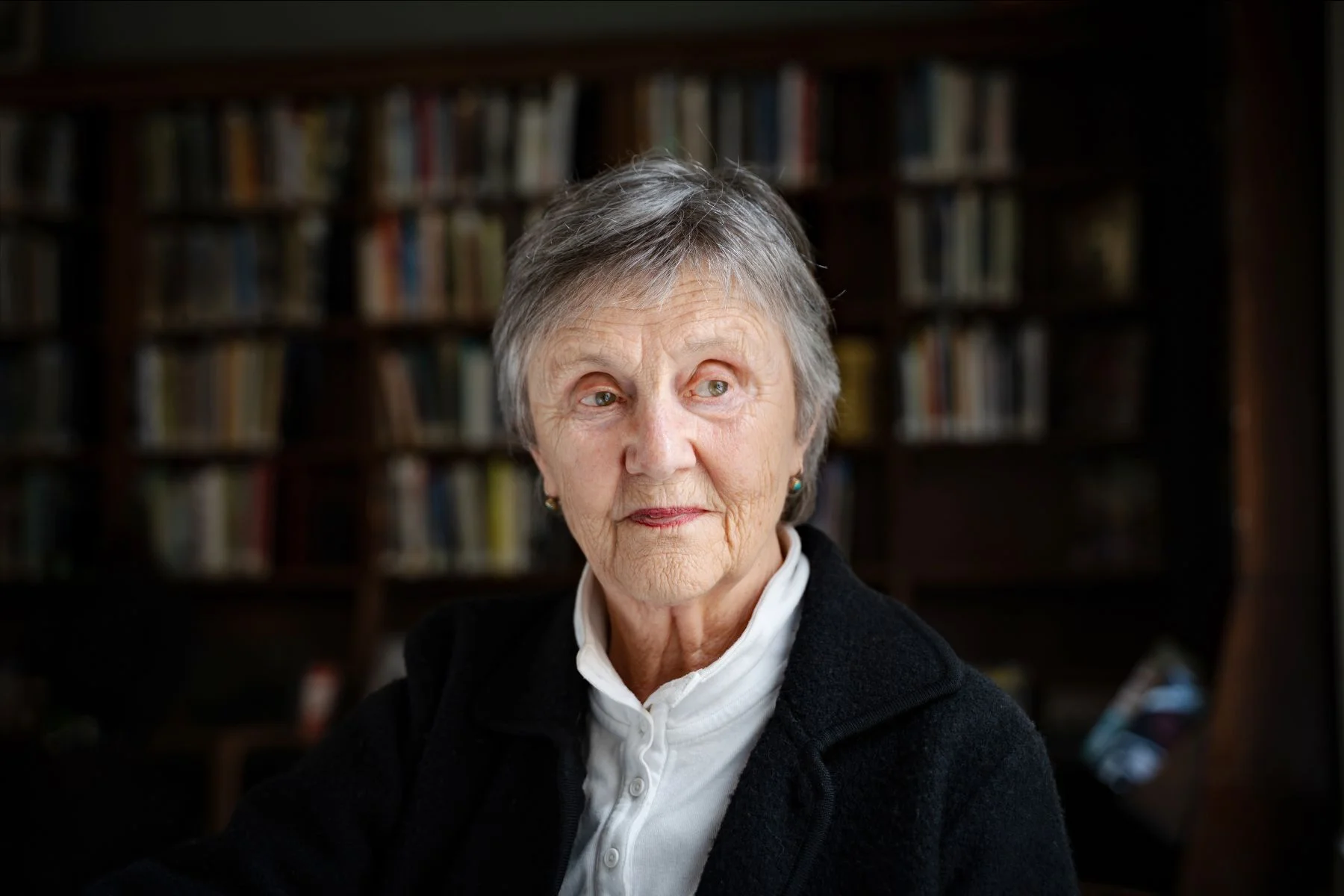
Photograph by Darren James.
Helen Garner’s work has long made private life matter as public subject. The Australian writer will receive the 2027 Hadada Award for lifetime achievement, joining a roster that includes John Ashbery, Anne Carson, Deborah Eisenberg, Jamaica Kincaid, N. Scott Momaday, Edward P. Jones and James Salter. Garner is set to receive the award at the Spring Revel on April 6.
The award recognizes a career that has moved between fiction, diaries, essays and reporting without abandoning a central interest: what people do to one another in the confined spaces of family, friendship and desire. Garner’s subjects may be intimate, but her writing has rarely treated intimacy as small or self-contained. Her work asks readers to consider how ordinary decisions acquire weight, and how people explain their own conduct when relationships begin to fail.
Domestic life as literary material
Garner’s debut novel, Monkey Grip (1977), drew on her life in Melbourne share houses in the early 1970s. She was raising her young daughter among a community of mostly single mothers, writing in her diary and falling in love with a man addicted to heroin. As the relationship developed, Garner recognized its narrative shape. “Story is a chunk of life with a bend in it, and I could feel this one coming,” she told Thessaly La Force in The Art of Fiction No. 255.
That account helps explain the book’s method: lived experience supplies the material, while attention and form turn it into a story. The distinction matters. A writer can draw on personal life without simply reproducing it, and Garner’s description suggests that she was alert to the way events gathered shape even as she was living through them. The result makes private choices available for public scrutiny without pretending that they’re neat or easily resolved.
Published in 1977, Monkey Grip won the National Book Council Awards’ first prize and unsettled some critics with its portrayal of unconventional households, sexuality and female desire. Critics objected that Garner had published what amounted to a journal. She later defended the labor of diary writing, arguing in a 2002 essay that it did not simply emerge as an unfiltered stream. Three volumes of her diaries, covering 1978 to 1998, have since appeared.
The old objection—that a work drawn from a diary must be raw or insufficiently shaped—underestimates the choices involved in recording a life. What gets noticed, written down, returned to and left out all affect the story a reader receives. Garner’s later defense of diary writing points to that process as work in its own right. This is more significant than it looks: her writing makes observation feel immediate while keeping the reader aware that immediacy has been constructed.
Born in Geelong, Victoria, in 1942, Garner was the eldest of six children. Reading offered her a private space within a crowded family. “It was my way of being absent,” she recalled in her interview with La Force, describing how she kept reading while getting dressed.
That memory gives her interest in domestic life an early context. A crowded home can be a place of closeness, but it can also leave a person searching for a little distance and a way to pay attention. Garner’s writing often holds both conditions together: the need to belong and the desire to observe from just outside the action. A reader gets the small scene, and the pressure beneath it.
Family at the center
Family life, especially when it begins to fracture, recurs across Garner’s fiction. In The Children’s Bach (1984), a couple’s carefully contained existence is disrupted by the arrival of an old friend’s bohemian family. The Spare Room (2008) examines the strain of caring for a friend pursuing alternative cancer treatment.
These premises place people inside relationships they can’t simply step away from. The disturbance in The Children’s Bach tests the boundaries a couple has built around its life; in The Spare Room, care becomes an intimate, exhausting obligation shaped by another person’s choices. Garner’s focus is not on domestic arrangements as scenery. It’s on how private loyalties become difficult to maintain when desire, illness or another person’s needs press against them.
Her nonfiction has also followed family relationships into painful territory. Joe Cinque’s Consolation (2004) recounts the case of a young woman who killed her boyfriend; This House of Grief (2014) follows the trial of a father who drove himself and his three children into a dam, killing them. Garner has said that family is where “everything is played out,” despite being told her concerns were too domestic.
Reporting these cases requires a different kind of attention from writing a novel, but the underlying question is familiar: how do people behave when the bonds that should offer care or trust become sites of harm? Garner’s nonfiction turns toward facts and public proceedings while keeping human relationships in view. Here’s the thing: calling such work “domestic” can make its subject sound narrow, even when it addresses responsibility, grief and the stories people tell about one another.
And yet, the subjects resist easy moral distance. A reader may want a clean explanation for violence or betrayal; close reporting and close observation can instead expose how little comfort a simple answer offers. Garner’s writing keeps that discomfort in view. Sometimes, the record itself is the hardest thing to sit with.
A lifetime of looking closely
Across five decades of novels, journalism and essays, Garner has built a reputation for close observation and unsparing emotional clarity. Her honors include the Windham-Campbell Prize, the Melbourne Prize for Literature and the Walkley Award, as well as induction into the Victorian Honour Roll of Women. The Hadada adds a lifetime achievement honor to that record, recognizing a body of work that has repeatedly found wider significance in the intimate details of ordinary life.
The range of those forms matters because Garner’s work doesn’t depend on a single genre to make its case. Fiction can shape experience through character and structure; diaries preserve a writer’s attention across time; nonfiction places people and events against a public record. Together, they show a career built around looking closely, while accepting that close attention can complicate rather than settle a judgment.
What the award recognizes
The Hadada’s recognition places Garner among writers whose work has left a lasting mark across different forms and traditions. For readers encountering her through one book, the award also offers a reason to look across the larger body of work: the recurring interest in private conduct links novels, diaries and reported cases, even as each form asks something different of its author and its audience.
If you’re working in this space, Garner’s career offers a useful reminder that material doesn’t need to be grand in scale to carry public meaning. A household, a friendship or a strained act of care can reveal the expectations people live by, and the damage those expectations may conceal. That doesn’t make every domestic story consequential by default; it makes the quality of the attention decisive.
The award therefore recognizes more than longevity or a list of honors. It affirms the force of a method: starting with particular lives, resisting easy conclusions and asking what those lives show about the people around them. Garner’s work has made that method matter to readers for decades, and the Hadada gives it a fitting place in the record of her career.


