Forrest Gander has two books coming out in spring 2027, three weeks apart, and the covers suggest how differently each one wants to be read. Milkweed publishes the novel The Weight of a Frozen Moment on April 6, 2027. New Directions follows on April 27 with Dune Lines: New and Selected Poems. Pre-orders are open for both. Put them side by side and you get a novel about one family's gravity and a poet's forty-year accounting of his own work, tied together by the same preoccupation with time, place, and the body.
A novel where the mountains hold the story
The novel opens in a small intentional community in California's Sierra Nevada. Two sisters, Maya and Mira, share explorations, secrets, and the sense that their lives run on parallel tracks. Then adolescence pulls Mira away, first gently and then for good. Maya has to remake herself alone. The pressure comes from grief and family tragedy, from a trip to Karnataka to mark the anniversary of their father's death, and from a bond with the land that grows deeper as the rest of her life loosens.
Gander's prose is restrained, and that restraint is the point. His attention to the natural world gives the setting a pull that feels almost like a plot device. The Sierra Nevada works as witness and as anchor. It's also the ground on which the sisters eventually find their way back to each other, and to a wider sense of belonging than either had at the start. I expect many readers will finish the book thinking about the place more than the people, which is a rare thing to pull off in literary fiction.
The book is also a meditation on identity and on ties that survive distance. Its best line of argument is that being separate and being inseparable aren't opposites. Gander treats estrangement as something that can coexist with deep connection, and he doesn't rush to resolve the tension for the reader.
A cover made from a 1935 lithograph
The cover comes from designer Mary Austin Speaker, who is drawn to vintage artwork made before AI, partly out of respect for the artists who made their work by hand. The image began as a lithograph of Latourelle Falls printed by the Wesley Andrews company in 1935, and the slightly off-register colors are a big part of its appeal. The forest pressing in at the edges makes the scene feel like a private discovery rather than a postcard view.
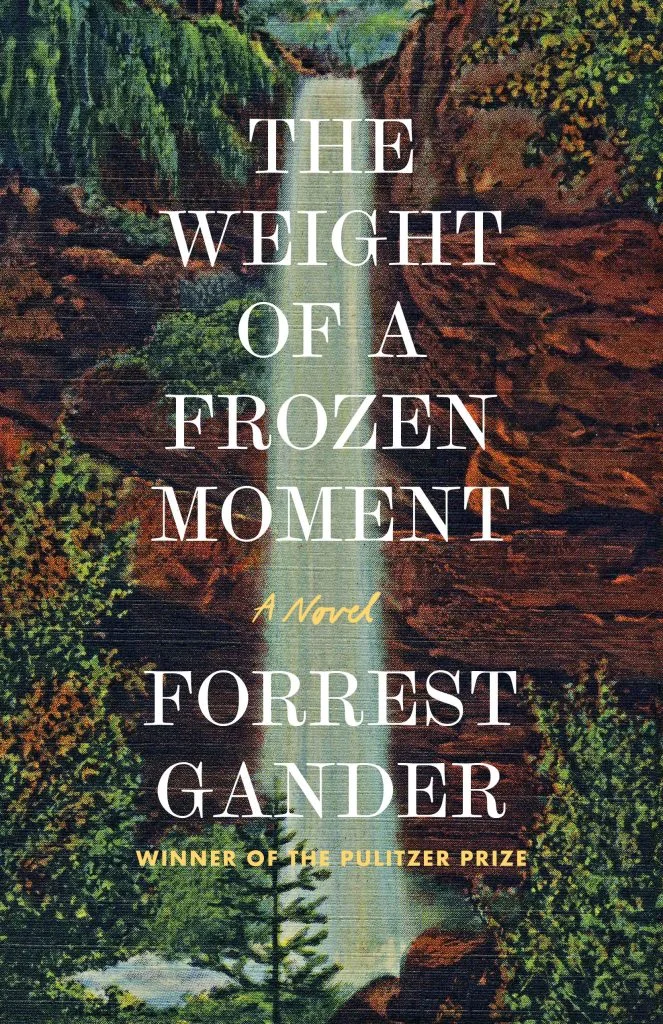
Speaker's reasoning is useful for anyone thinking about cover design. Waterfall photographs tend toward cliché, so she went for something saturated and painterly. Lithographic postcards from that period were printed before reliable color photography and then hand-tinted, which makes them a blend of the real and the imagined. Speaker says that blend gives them an eerie quality, and she sees the same thing in memory, where certain scenes stay vivid while everything around them goes dark.
Gander reads the image as a metaphor more than a scene. It's hard to tell whether you're looking at a painting, a drawing, a lithograph, or a photograph. He points to the heavy, fractured rock that softens the sheer fall of water, and to the forest's darkness, which looks more like a waiting room than a threat. That's the territory the novel covers: Maya, who is trying to reckon with a version of herself she can't fully get back into, while her sister drifts into adulthood and her father gets sick. Gander also notes that the cover doesn't show the transnational side of the book. The foothills over the Yuba River Canyon and Tahoe National Forest may be the real main character, and the cover handles that well enough.
Forty years of poems in one volume
Dune Lines pulls from four decades of Gander's books. It asks questions that don't have tidy answers. What does an ethical life look like? An erotic one? What does it mean to be built out of other people, and other kinds of beings? Which parts of love and grief hold a person up, and which just weigh them down? The poems move from the intimate to the geological. They're worldly in scale and personal in focus, and they keep shifting between human time and the much longer clock of the earth.
For readers who already know Gander, the collection works as a map of his career. For readers who don't, it's a clean entry point, since the selection covers his best-known poems and shows how he found an approach to contemporary poetry that doesn't resemble anyone else's. The book includes sections from Mojave Ghost, a work that records a hike along the San Andreas fault into the Mojave Desert, where Gander was born. The pairing of the fault line with his own origins makes that section feel like a hinge in the collection.
A cover that looks like a seismograph
The cover for Dune Lines comes from Rodrigo Corral and Giacomo Girardi. It's the third Gander book in a row designed by Rodrigo Corral Studios, and the approach stays spare. A single repeated vertical mark swells and narrows, and it's easy to read it as cymatics, oscilloscope output, or the rise and fall of breath. Gander says that breathing is a central part of his poetic process, and he sees that rhythm in the cover's throb and ebb.
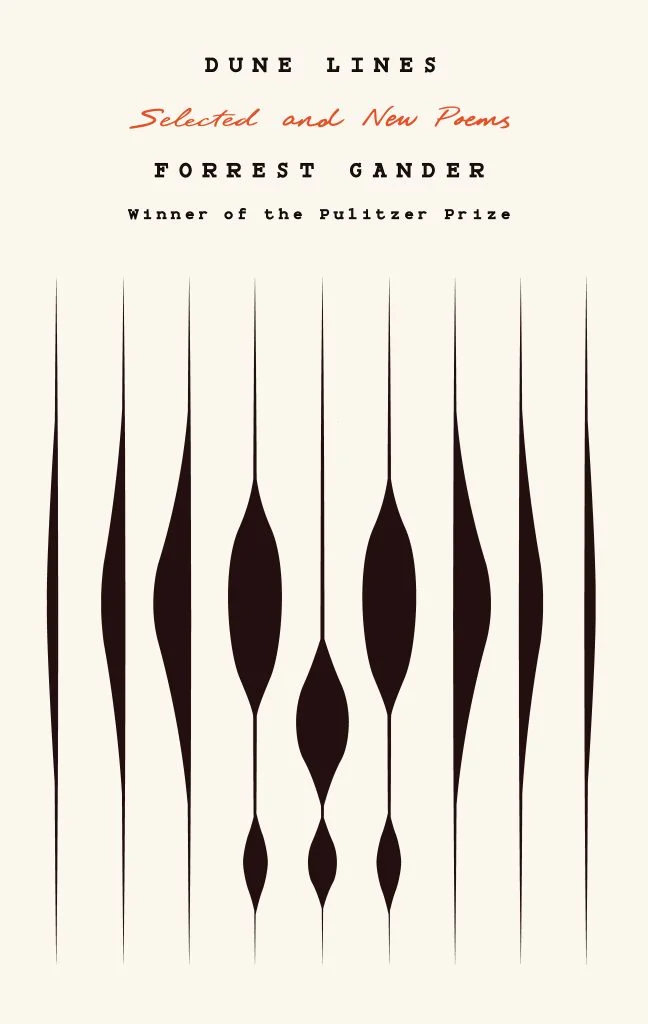
Gander's comparisons are specific. He thinks of Bridget Riley's early black-and-white Op Art and of the formal discipline in Ellsworth Kelly's drawings. The shapes could be reeds, ribs, or a seismograph trace, or, as he puts it, dune lines standing upright. That reading fits the collection, which often takes one theme or event and examines it from several angles.
Corral's reading goes further. He describes the cover as a movement between motion and stillness. The shifting line weights represent the dunes, and they converge in the middle to form a skull. For Corral, that image holds the cyclical nature of life and grief and memory, along with what it means to be human inside a natural world that runs on a geological timescale. Two designers and a poet agree on the core idea, which is that the surface of a book can carry a rhythm before a reader opens it.
That's where I'd watch this pairing. The novel anchors its meaning in one landscape and one family. The poetry collection stretches across forty years and several geographies. Read together, they make the case that Gander's real subject is how a single life gets measured against much larger clocks. Spring 2027 will show whether readers come to them as a set.


