Bruges-la-Morte by Georges Rodenbach
Rodenbach’s 1892 novel is the first work of fiction its author deliberately designed to include photographs. You can [view the original online](https://archive.org/details/brugeslamorterom00rode/page/n7/mode/2up), and an English translation exists, though its images come with a serious caveat. The story follows a wealthy young widower mourning his wife in Bruges. He wanders past canals and old stone buildings, seeing his lost wife in the city’s deserted streets and in church spires reflected on the water. Rodenbach’s photographs make that grief visible: the reader follows the widower’s thoughts while looking at a city emptied of people. Then he meets a woman who resembles his dead wife, and the story turns. The Dedalus English translation replaces Rodenbach’s photographs with pictures taken by the translator. His explanation is that Bruges looked much as Rodenbach’s images suggested, so he substituted his own photographs. That seems a grave mistake. Rodenbach [chose his images carefully](https://writingwithimages.com/georges-rodenbach-bruges-la-morte/), and those pictures are part of how the novel works. If you read the translation, it’s better to consult the [original images](https://archive.org/details/brugeslamorterom00rode/page/n7/mode/2up) alongside it.Nadja by André Breton
André Breton, a leading theorist of surrealism, casts himself as the protagonist of this autofiction about an affair with Nadja, an eccentric woman whose disquieting remarks strike him as poetry. The photographs, commissioned by Breton, show places where the two met. The book’s structure is unsettling. Breton begins with an essay on subjects ranging from art to capitalism, tells the story of Nadja in the middle, then returns to essay form to describe her breakdown, psychosis, and transfer to an asylum. He says he never visited her there. His account suggests he believed she had crossed some boundary beyond which he could no longer reach her—or perhaps no longer wanted to. He was married during the events he recounts, but barely mentions his wife. It would be easy to assume Nadja is a fictional invention. She was real. Her strange drawings and letters to Breton are [available online](https://www.andrebreton.fr/work/56600100397790). He reproduces some of her drawings in the book without explaining how he obtained them or what they mean.The Arrière-Pays by Yves Bonnefoy
Yves Bonnefoy, who died in 2016, was a French poet. *The Arrière-Pays*, translated by Stephen Romer, follows a narrator who calls himself “the author” and tells stories about “the traveler.” Both figures dream. Eventually, it becomes hard to tell which places they’ve visited and which they’ve imagined. “Back country” is a suggestive translation of *arrière-pays*: a place beyond the tourist route, perhaps remote or inaccessible. The book moves through imagined and faraway places in Turkey, the Caucasus, Corsica, and Mexico, with reproductions of paintings alongside its photographs. The paintings appear in color; many of the landscape photographs are black and white. Bonnefoy explained the choice this way: > “Certain old photographs of monuments or villages clinging to hillsides, on the horizon. The photographs are old, not because the *arrière pays* belongs to the past but because such images, technically of poor quality, simplify what they represent, which one would otherwise understand too easily.” That’s a compelling account of what an imperfect image can do. A photograph that withholds detail keeps a place from becoming too easy to grasp, preserving something of the uncertainty of a dream. The result is a lovely book to wander through—a travel book for staying put.The Rings of Saturn by W. G. Sebald
Sebald’s *The Rings of Saturn*, translated by Michael Hulse, is a lonely, hypnotic walk through the coast of England near the University of East Anglia, where Sebald worked. Its photographs range from marshes, beaches, inlets, and headlands to historical images of the people and places that inhabit the book’s past. Grainy views of empty landscapes sit beside grand buildings and writers’ portraits. The effect is disorienting: the reader seems to drift along the coast while falling through history. By 1995, after *Vertigo* and *[The Emigrants](https://bookshop.org/a/269/9780811226141)*, Sebald had developed a consistent method for placing photographs in his books. In *The Rings of Saturn*, he usually identifies the subject of an image within two lines before or after it, in both the German and English editions. You sense the picture approaching, see it, then learn what it depicts—or read the identification just before the image appears. This keeps the narrative moving across the pictures instead of stopping to inspect them or check a detail. There are exceptions, including a Rembrandt painting and a horrifying photograph of a killing field at Bergen-Belsen. Of Sebald’s books, this one makes the clearest case for his method and the strongest use of black-and-white photography. If you’re new to his work with images, it’s the best place to start.The Xenotext by Christian Bök
Published in 2015, Christian Bök’s *The Xenotext* stretches the word “experimental.” Bök, whose surname is pronounced “book,” is a Canadian writer who now teaches in Leeds. For more than 20 years, he worked in bioart, engineering genetic material to make artworks from living organisms. Artists including Eduardo Kac, Joe Davis, and Adam Zaretsky have also worked in the field. Bök’s aim is poetry. Some bioartists have encoded messages or images in DNA and placed that DNA in organisms such as bacteria, giving each bacterium a copy. Bök’s project goes further: he encoded a poem into DNA and arranged the genetics so that the bacterium would produce genetic material in response—another poem. The bacteria, in effect, become poets. [Book 2](https://bookshop.org/a/269/9781552454985), published in 2025, presents the project’s conclusion. The first book introduces the idea through poetry rather than a technical account. It opens with long verse chapters that mix grand, old-fashioned language—“What dire seed must these onslaughts have scattered, like shrapnel, across your cremated badlands”—with contemporary science. A translation of Virgil’s fourth *[Georgic](https://bookshop.org/a/269/9781025224091)* appears with little explanation. Later come constrained writing, poems shaped like molecules, and computer-generated protein diagrams. This may be the most radical book here. It can be difficult going, but it stays with you.Nox by Anne Carson
Anne Carson’s fame helped keep the original price of *Nox* below $30. The book comes in a sturdy box and contains an accordion volume that, fully unfolded, stretches more than 30 feet. Comparable artist’s books can cost hundreds of dollars. Yet *Nox* doesn’t quite work like an artist’s book, which can generally be read in any order. Carson’s two intertwined narratives make more sense from the first accordion page to the last. Every third or fourth page studies a single Latin word, following the sequence of a poem by Catullus that opens the book. The remaining pages reproduce Carson’s notebook through collages of photographs, letters, drawings, and prose. Those fragments reveal a book of mourning for Carson’s estranged brother, who has died. Midway through, she explains that Catullus’s ancient Roman poem is also about a brother’s death; later, she offers her own translation. In the notebook pages, she records how little she knew her brother and responds by tearing up one of his few letters, then taping and gluing photographs and drawings into the book. The collages feel intimate and immediate. The pages devoted to Catullus’s words are dense and melancholy, and some readers may be tempted to skip them. They slow the book down in a way that deepens its grief. *Nox* makes visible a painful problem for any writer: how to turn private loss into a book that another person can enter.Seven Controlled Vocabularies by Tan Lin
Tan Lin’s *Seven Controlled Vocabularies and Obituary 2004: The Joy of Cooking* is strange by design. It exists as a paperback, but it was also “republished” at an event at the University of Pennsylvania on April 21, 2010. Several dozen people contributed texts that became official parts of the book; some are collected [online](http://aphasic-letters.com/edit/publications.html). Lin’s images aren’t there to impress. They include the back of a utility bill, a New York City Metro card, and a photograph found at a flea market. Often small and surrounded by blank space, they share the book with short essays, many only a paragraph long. Even the cover resists attention, with a large bar code and no image. One paragraph, titled “PRADA,” considers how fashion logos are seen without really being read. We recognize the initials on a Prada bag, Lin suggests, but “not in any meaningful way. After all, who has really read a bag by Louis Vuitton”? Below the paragraph sits a small image that looks like a credit card or transit pass. Lin’s question, “What are the forms of non-reading?”, gets at the book’s quiet provocation. We move through a world crowded with text and images that barely register. Why should writing always command our attention?These books make a strong case that images can do more than decorate a text: they can change how a reader moves through it, and what the reader notices. That difference is clearest in the contrast between Teju Cole’s guided photographs, Claudia Rankine’s deliberately unresolved pairings, and Barbara Browning’s novel that spills onto YouTube.
Traveling with Teju Cole
Blind Spot pairs Cole’s photographs with explanatory text on facing pages. A Nigerian-American novelist, photographer, and theorist, Cole became known to many readers through Every Day Is for the Thief and later reached a different audience with his photography column for The New York Times. He is now the Gore Vidal Professor of the Practice of Creative Writing at Harvard.
Cole takes up W. G. Sebald’s wandering narrator, attentive to what turns up along the way, but his travels cover more ground and his historical frame is wider. Blind Spot considers genocides affecting Balinese, First Nation, German, Syrian, and Swiss communities. Its full-color photographs also look nothing like the nostalgic grayscale associated with Sebald’s work. The resemblance is in the method of looking; the voice and visual palette are Cole’s own.
Here’s the more revealing difference: Cole explains what he sees. He points readers toward details, discusses what he learned on his travels, and describes how he made the photographs. Sebald generally left his camera and lens choices out of his books; researchers later uncovered some of that photographic history, and a Sebald archive now holds images he didn’t use. Cole makes the process part of the reading. That’s a distinct approach to autofiction with images, and it asks readers to follow his attention rather than reconstruct it after the fact.
Claudia Rankine leaves the contrast open
Citizen brings images into a book about the ordinary injuries of being Black in America. Rankine writes with urgency about microaggressions and the racist assumptions that shape daily encounters, whether those assumptions are unconscious or deliberate. Compared with her earlier Don’t Let Me Be Lonely (2004), where photographs could feel like optional ornaments, the images in this 2014 book take a more active role.
Works by Black American artists including Carrie Mae Weems, Nick Cave, and Glenn Ligon sit alongside accounts of prejudice, bullying, and casual disregard. A story about racism at a grocery checkout may be followed by art that has received international reviews or entered museums and private collections. The jump is striking. Rankine doesn’t spell out what readers should make of it.
Other images widen the gap further: Caroline Wozniacki posing as Serena Williams, Hennessy Youngman, and unremarkable outdoor scenes. Their meaning remains unstated in a text sharply alert to how people fail to examine their own attitudes. That silence has force. It leaves readers to sit with the mismatch instead of receiving a tidy explanation.
A novel that sends you to YouTube
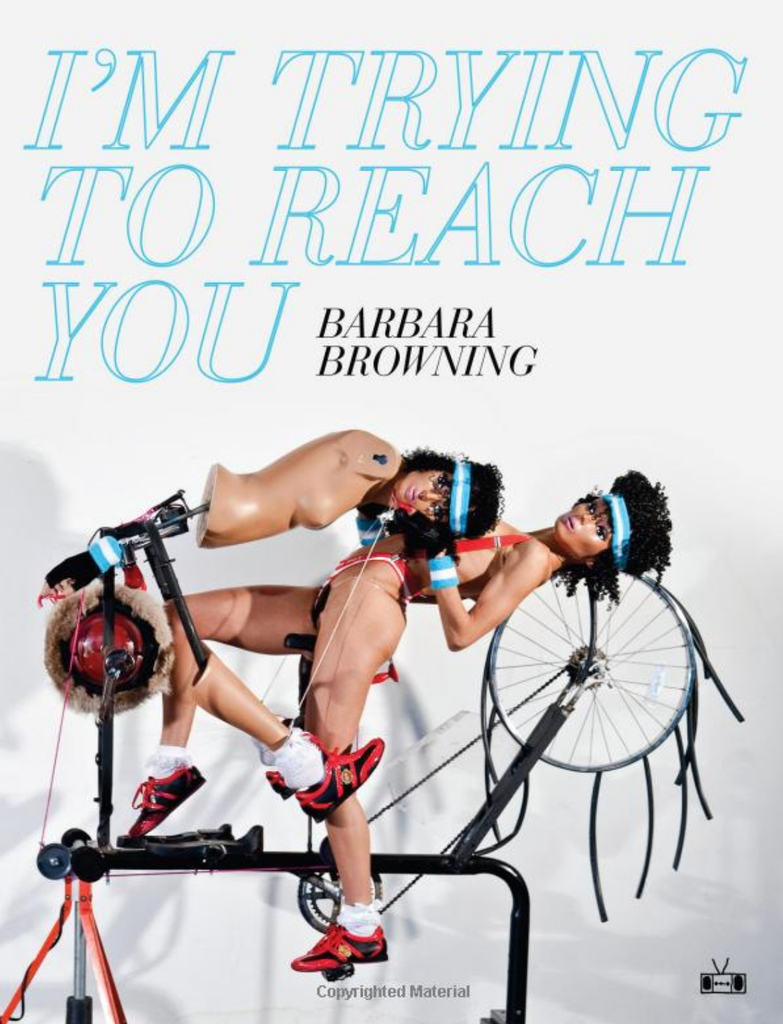
Barbara Browning’s I’m Trying to Reach You is built around a less settled boundary: the one between a printed novel and online video. Alongside ordinary photographs, mostly taken on a phone, it includes YouTube screenshots. A QR code on the dedication page directs readers to the videos made by “the moth.”
Those videos become central to the plot, as do comments from viewers that Browning quotes in the book. You can follow the story without opening YouTube, but then you’re working from grayscale stills and descriptions. Watching as you read adds another layer—and lets you see the public view counts, a detail an e-book can’t reproduce in the same way.
The first of the 12 videos has consistently attracted the most viewers. It had 1,011 views in April 2014, 1,500 in 2019, and was nearing 1,900 more recently; the counts drop quickly across the remaining videos. That pattern suggests some viewers didn’t continue through the sequence, though the numbers alone can’t tell us why. Browning further blurs fiction and life with a two-part author photograph that strongly resembles the dancer called “the moth.”
I keep moving between the paperback and the videos. On a Kindle, I imagine the experience would feel more like following links through a digital text. In print, the friction between the physical book and the changing online material is part of what stays with you. The images here range from carefully explained to pointedly unexplained to impossible to contain on the page. That variety is the point: sometimes a picture holds your attention for a moment, and sometimes it keeps opening the book back up.


