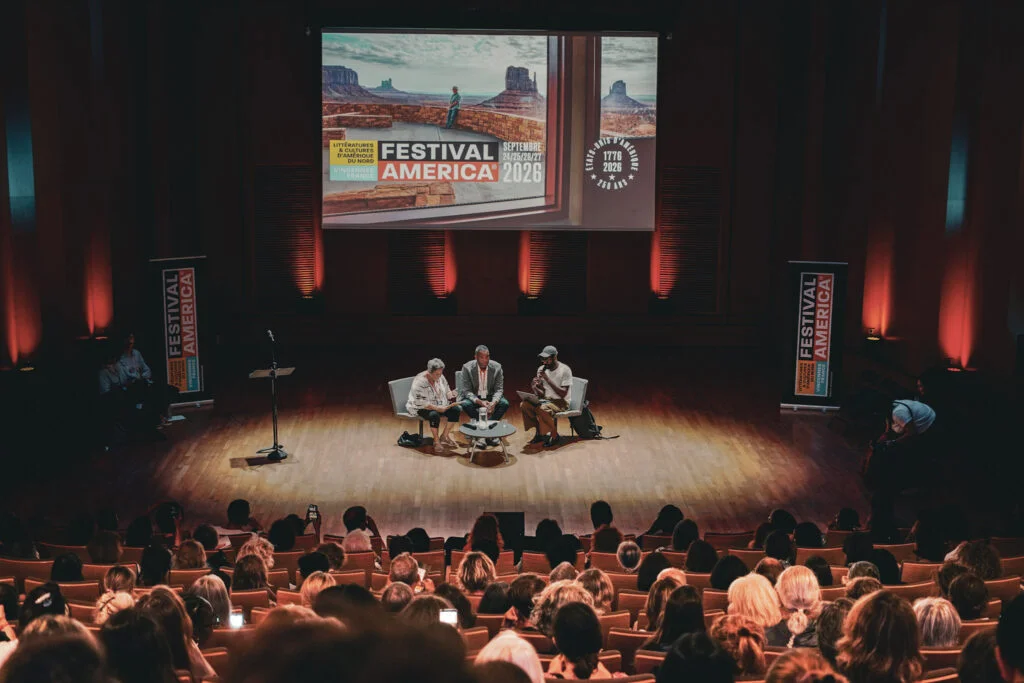
Ta-Nehisi Coates panel. © Siriot de la Petra.
A festival looking at America from France
Festival America’s 2026 trailer makes a forceful argument before a writer says a word: American literature can’t be separated from the country’s history. Its montage races from Native American riders and George Washington to the Wounded Knee massacre, a mass grave, the suffrage movement, Normandy, a nuclear blast and a rocket launch. Then come three lines in French: Littérature. Expositions. 60 autrices et auteurs américains.
Littérature.
Expositions.
60 autrices et auteurs américains.
Portraits of John Grisham, Joyce Carol Oates, Laura Kasischke and Ta-Nehisi Coates appear over footage of the March on Washington. Sixty authors’ names scroll across images of men going to war. The mostly monochrome film shifts to color for Ronald Reagan signing a bill and a plane striking the Twin Towers. It’s a stark frame for a literary festival: the books arrive alongside the history, violence and politics that shape them.
Held every two years in Vincennes, just outside Paris, Festival America usually brings together writers from the United States, Canada, Mexico and the Caribbean whose books have recently appeared in French translation. The 2026 edition narrowed its focus to the United States for the country’s 250th anniversary. Its guests included Alison Bechdel, Tommy Orange, Viet Thanh Nguyen, Karen Russell and Patrick Radden Keefe, along with dozens of other established and working writers. Jake, my husband, was on the list too, and felt distinctly out of place.
His first novel, Slime Line, came out quietly from West Virginia University Press. When he signed with a larger New York imprint for his next book, his editor still called him a “debut author.” Yet a major French publisher had bought the novel, released there as Alaska Parano. Two years after its American publication, Jake and I arrived in Paris to find copies on a bookstore’s NEW AND NOTABLE table, in another shop nearby, and marked as a STAFF PICK at Shakespeare and Company.
That attention helped explain the admiring messages Jake had been getting from French-language Instagram accounts. One described his novel, drawn from his time in the commercial-fishing industry, as a beautiful meditation on the “solidarity of magnificent losers.” His French publicist soon asked whether he’d speak with a journalist from a major French magazine for a profile as the “new voice of America.” The response suggested that his working-class subject matter had found an audience with a particular appetite. I wanted to understand why.
What French readers seek in American books
My interest in French literary taste had competition from wine and cheese. On the festival’s first full day, authors and their guests gathered for a “cocktail lunch” at the Château de Vincennes, once the seat of French kings from the fourteenth to the seventeenth centuries. We ate radish slices on skewers, thin breads with charcuterie and small meringues beneath Europe’s tallest donjon.
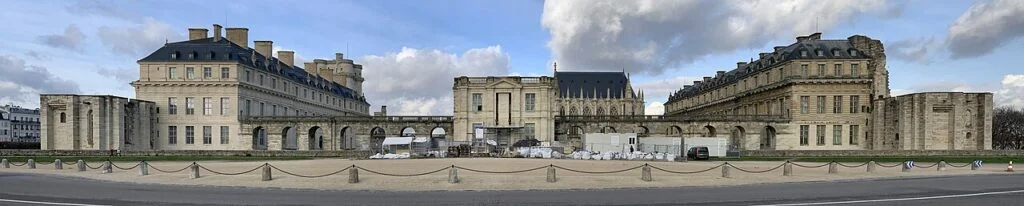
Château de Vincennes, CC BY-SA 4.0, via Wikimedia Commons.
I asked the festival’s head interpreter whether the château had any torture instruments on display. Disease, she said, had proved deadlier. After the Siege of Meaux, Henry V of England retreated there in 1422. He had conquered Normandy and was close to becoming king of France; soon after settling in, he contracted dysentery and died.
The episode made the festival’s American anniversary feel especially young. “Compared to Europe, it’s very recent,” founder Francis Geffard said of the United States. Still, the 250-year mark offered “a good occasion” to bring American writers together and ask what their fiction might mean to readers abroad. It’s an ambitious question, and one that would be hard to answer from inside the country. As Geffard put it, writers rarely turn down a free trip to Paris.
After lunch, Geffard moderated a French-language discussion called “The French Taste for American Literature” at Vincennes’s nineteenth-century town hall. More than two hundred people climbed the grand staircase to the marriage hall, where painted aristocrats watched from the walls. The route in passed a red carpet and a photography exhibition that included migrants crossing the Rio Grande. The previous festival had attracted 60,000 visitors; the press team expected this year’s crowd to be comparable.
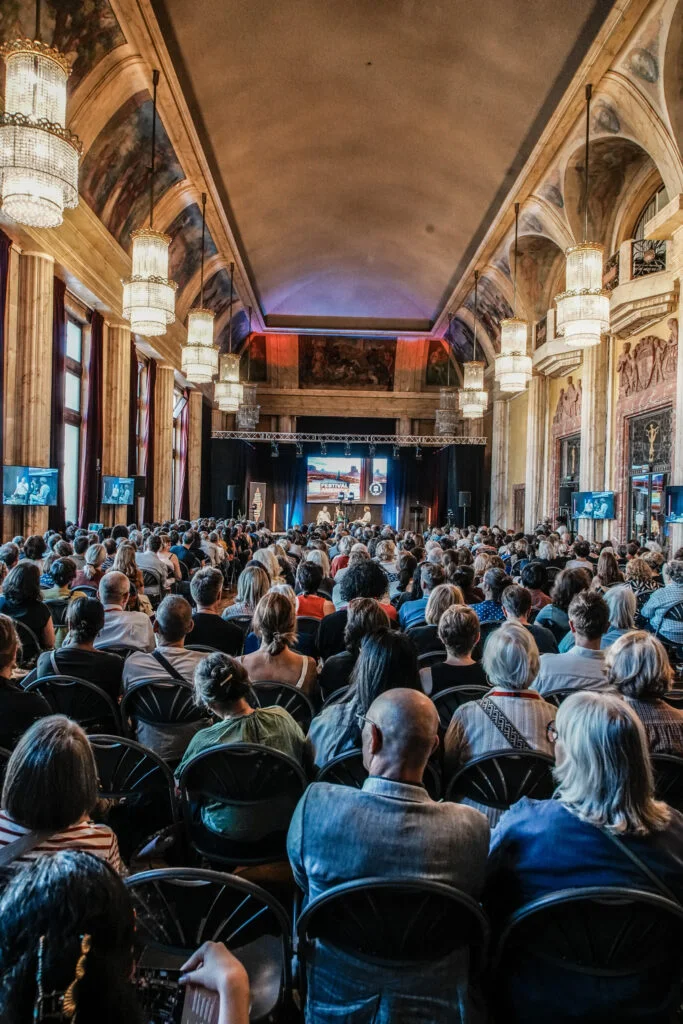
The panel began with two assumptions that were striking to hear stated aloud: American writers differ from French ones, and people in France often picture the United States as a country without culture. Sébastien Bonifay, a Corsican writer and bookseller, offered a more particular account. He has traveled to the United States more than twenty times to visit favorite writers, sometimes staying with them for days. His book (Not) Born in the USA recounts encounters with James Ellroy, Chris Offutt, Donald Ray Pollock, Stuart Dybek, James McBride and others. “The literature that nourishes me,” he said, “is an American literature that Americans don’t like.”
Bonifay called it “a literature of the margins.” The panelists connected those margins to countercultures that oppose l’establishment, from rock and roll to psychedelia and punk. One described two American literary traditions: the coastal one and “the other,” less often published but frequently excellent. University presses, the panelist said, publish much of this work—and have “wonderful presses.” Mainstream acclaim seemed beside the point. The panelists trusted their own judgment.
They also described a writer who sounded a lot like Jake: someone who fits writing around blue-collar jobs, brings lived experience to the page and has worked outside the usual literary centers. One panelist called this an “American-style résumé.” Places like Ohio, they suggested, held experiences French readers could barely picture.
Bonifay told me his interest in those places began at fourteen, with Stephen King. The horror wasn’t what hooked him. It was King’s description of small-town America, especially Derry, his fictional Maine town. In Bonifay’s telling, the setting drew him in before the plot did. I understood the appeal; I grew up in an American town myself.
French readers, Bonifay said, often embrace writers who have little recognition at home, or sometimes aren’t published in the United States at all. He thinks France’s own history plays a part. “French people, they’ve got a problem with America,” he said. “We are fascinated by America. But we truly, deeply think we should be, as France, as a country, where America is.” American fiction that succeeds in France often focuses on the country’s rougher side, he added.
Benjamin Whitmer’s crime novels are one example. Bonifay had visited him in Colorado. Whitmer owned thirteen guns, a detail Bonifay repeated with delight: “Benjamin Whitmer knows Maurice Blanchot. He reads Maurice Blanchot, and he’s got thirteen guns.” One was for grizzlies, another for coyotes. The combination punctured a French stereotype of gun owners as rednecks. For Bonifay, Whitmer’s reading and his arsenal belonged in the same portrait.
His enthusiasm came with a blunt preference. “It’s just my opinion, but these writers are a lot better than the other ones,” he said. “Really, I don’t care about Jeffrey Eugenides! Really, I don’t care.”
The American writers outside the frame
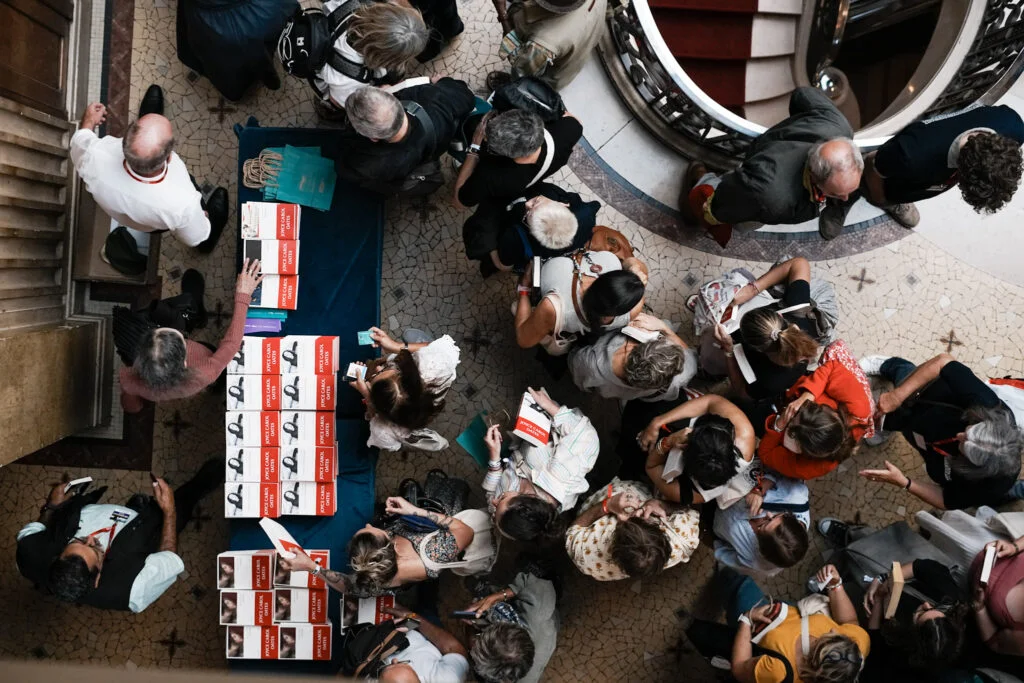
© Siriot de la Petra.
Jake, whose book came from West Virginia University Press, was already selling copies in the festival’s book tent. A class of teenagers had just surrounded him after a talk. When I told him about Bonifay, he laughed: “That guy rules. I think he wants us to come to Corsica.”
Joyce Maynard’s signing line curled around the booths. I asked two women browsing nearby what drew them to American literature. “The stories, the journey, the wide-open spaces, and all that,” one said. They had come to learn about America, and their questions turned me into an impromptu exhibit. When I described Jake’s work, she said that a French writer wouldn’t write about being a fisherman. “In France, it’s more l’establishment.”
Her companion explained: French writers were “professionals.” She had expected a writer interested in capitalism to be more like a banker. The younger woman then pointed me toward a figure she thought would help explain French literature: the woman in the black hat and red lipstick. Her friend said the woman had “her own myth.”
I didn’t follow their remarks about le wokisme, and worried my French had failed me. Later, I worked out that they meant Amélie Nothomb, a Belgian Francophone novelist known for large hats and television appearances. King Philippe made her a baroness.
French literary life seemed full of characters. Rob Franklin, another novelist at the festival, told me he met an older woman called Sophie at the opening ceremony. She had a pixie cut, an eccentric style and a monocle, which she used to check her schedule before asking to photograph him. Rob assumed she was his French editor, also named Sophie.
The next day, he went to meet his publisher and found a different Sophie. He spent the festival wondering who had taken his portrait until the first woman found him again on the last day and handed him her card. She was France’s best-known photographer of writers, and had been making portraits for sixty years. “I found out she’s like … quite famous,” Rob said. Her card featured a black-and-white portrait she had taken of Michel Foucault.
Who counts as the establishment?
Fabienne Gondrand, the literary translator who interpreted Jake’s comments throughout the festival, was the person I wanted to ask about l’establishment. Several people had used the term to describe differences between French and American fiction. I wondered whether she also saw American writers as more opposed to it.
“That’s a little reductive,” she said. She suggested that festivalgoers might have used the term because the program included diverse voices, among them nonwhite and Indigenous writers challenging American cultural norms. I had been too quick to turn a few comments into a tidy split between coastal literary insiders and scrappy writers with day jobs. And the phrase “the American establishment” had a more literal target in Vincennes: Charles Kushner, the U.S. ambassador to France.
Since the festival began in 2002, Geffard told me, the American ambassador has given a speech on opening night. Kushner, a real-estate developer and pardoned felon, currently holds the post. The U.S. Embassy usually contributes some cultural funding to the festival, though less than Canada’s embassy. This year, it cut its contribution by 80 percent. Geffard read that as distrust and turned down the remaining money.
He said French people were “feeling a little estranged” from the United States. A festival press release issued shortly after our conversation put the funding cut in sharper terms: it had come, “ironically,” in the 250th anniversary year of the Declaration of Independence, while the festival hosted what it called the largest delegation of American writers ever assembled in France—and likely in Europe or anywhere else.
The gathering matters because these writers would rarely be grouped together in the United States. American readers tend to organize writers by subject, identity or genre; “American” alone doesn’t tell us much when we’re living inside the country. In Vincennes, distance made the label useful. French readers brought their own confidence about which American books deserved attention, and their tastes sometimes ran against the grain of American recognition.
When I got home, I found myself thinking about America from the outside—and then looking back at it from here. The embassy under Kushner was advising Americans to “exercise caution.” Since the festival, student protests there have erupted into widespread riots. It’s hard to imagine a clearer challenge to l’establishment.