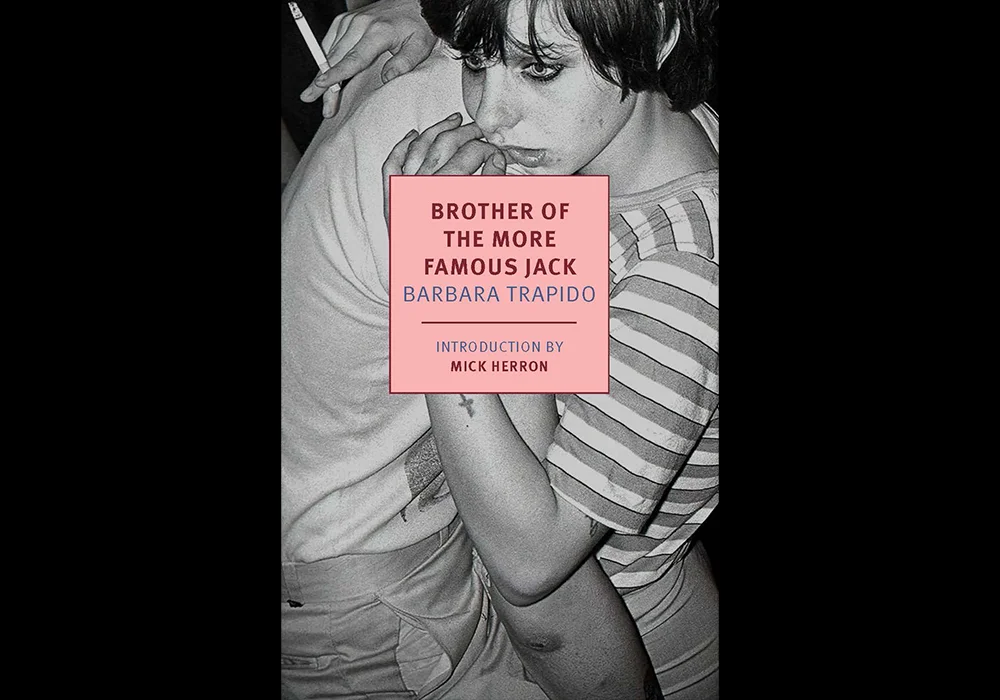
Barbara Trapido’s Brother of the More Famous Jack has the kind of influence that can become hard to see precisely because it settles into a reader’s instincts. First published in 1982 and reissued this year by New York Review Books, the novel follows Katherine, a young woman whose encounters with an unruly, politically engaged family help reset her expectations of adulthood, intimacy and everyday life. Its staying power lies less in a tightly engineered plot than in the company it keeps: vivid characters talking, disagreeing and making a home together.
Katherine enters the orbit of Jacob Goldman, a Marxist professor, and his wife Jane, who is beautiful, posh and ambivalent about raising six lively children. The household is far removed from Katherine’s conventional middle-class upbringing. At the Goldmans’ table, books, music, politics, sex and money all become subjects for spirited conversation. Their family life offers her a different model of how people might live together—one with less concern for respectability and more room for argument, appetite and affection.
The novel’s opening gives that change a compact emblem. Katherine reads a preface by Jacob in which he refuses the customary thanks to a wife who has edited a husband’s manuscript. Jane, he writes, has done none of that work; instead, he thanks her for her continuing presence, which he has never presumed to expect. Katherine says the preface influenced the paths she chose. Its force comes from the marriage it suggests: a relationship imagined through candour and mutual recognition, rather than a familiar division of intellectual labour.
A novel built through conversation
Trapido didn’t begin with a plan for the book’s shape. She started writing after a friend told her that she was dissipating her talent by telling stories aloud, and urged her to enter a Guardian short-story competition. Trapido was then working and teaching in Sunderland, travelling there by two buses from Durham. She began inventing the Goldman family and found she wanted to return to them.
At first, she treated the scenes as play. She imagined the characters going to the beach or the cinema, then worked on their exchanges late at night in secret. Her husband, Stanley, thought she was finishing a thesis on the Pre-Raphaelite poets. Before long, she knew she had written too much for a short story, though she still didn’t know what kind of book it was becoming.
Only after building up a substantial amount of material did Trapido wonder whether she was writing a soap opera, and what would give the episodes shape. She says the answer emerged intuitively, through recurring images: Monteverdi, a “Hamlet hat,” the older Goldman boys’ initials in capital letters, an embroidered butterfly and falsetto singing. Those details thread the episodes together. The forward pull, though, comes from the dialogue and the reader’s desire to stay with the characters.
That method suits a book whose pleasures are social as much as narrative. The Goldmans aren’t simply a device for changing Katherine’s outlook; their noisy household has its own momentum. Trapido describes the characters as imaginary, archetypal creations rather than portraits of people she knew. Katherine’s anticipation of university and adult freedom draws on Trapido’s own youth, while her sewing and attention to clothes are more directly personal. As a teenager, Trapido worked at a sewing machine with Vogue “Paris Original” patterns and slept in hair rollers to coax movement into her straight hair.
Class and the outsider’s point of view
Trapido’s family background provided a blueprint for the cross-cultural marriage between Jacob and Jane, even though she says neither character resembles anyone she knew. Her father grew up poor and won a scholarship to Leiden University in the Netherlands. Her mother came from a sheltered, bourgeois household in Berlin, with holiday homes, skiing trips and a boat on the Wannsee. The family lost everything during the Second World War. Trapido describes both parents as displaced foreigners in Cape Town.
That distance from the social worlds around her helped shape her way of observing them. Trapido calls herself an outsider, and says that position made her more anthropological in her attention to society. In Jack, the differences between pockets of middle-class life matter: they help explain what Katherine sees in the Goldmans and what their home makes possible for her. Jane’s reference to Jacob’s hunger for newsprint also connects the household’s political talk to its daily habits. If he can’t find his Guardian, she jokes, he’ll rummage through drawers for old issues of a local paper.
For Trapido, political and economic context also matters to literary reading. She recalls a graduate student insisting that social class had nothing to do with Wordsworth. Her response was that the conditions in which people grow up and try to survive shape how they think and write. The Goldmans’ talkative home gives that idea a domestic setting: politics isn’t a separate subject brought in for effect; it’s part of how these people understand the world around them.
Writing aloud, then finding the book’s rhythm
Trapido’s writing process is physical and auditory. She drafts by hand, reads the work aloud, revises heavily and reads it again. She may record herself and play the recording back, then continue speaking lines into a mirror. When arranging a scene, she imagines where everyone sits around a table and moves between chairs to perform the different voices. On a train journey, she works out which direction the characters face. The process helps her test dialogue while keeping track of practical details such as chronology, seasons, meals and whether someone can make a journey before a place closes.
She calls this work choreography rather than plotting. That distinction helps explain the book’s quick changes of scene and its limited attention to landscape. Trapido remembers that as a young reader she often skipped descriptive passages. In her own novel, she says, she dispensed with much of that description and moved quickly into speech. She sees a possible connection to Jane Austen’s dialogue, which can launch straight into an exchange without lingering over the scenery. She also remembers Iris Murdoch’s Under the Net, with its theatrical cast wandering through London, and Elaine Dundy’s The Dud Avocado as books she loved for the pleasure of being among their characters.
The novel’s editorial history reflects how much work had already gone into those voices. Trapido began the book about a decade before completing it, then set the manuscript aside when she moved from Durham to Oxford in 1970. Childcare and part-time teaching occupied much of the next decade. Around 1980, a conversation with a mother from her son’s playgroup prompted her to retrieve the manuscript from the attic and continue it as a serial for her friend.
By the time she revised it around age forty, the project had been worked over for years. A friend who typeset for Gollancz suggested submitting it. The publisher responded within a week, asking who the author was; Trapido recalls that the recent case of Doris Lessing submitting under another name may have made the editors suspicious that the manuscript came from someone more experienced. Her editor made almost no changes, correcting the spelling of “righteous” and adding three commas. One comma prompted a phone call about the punctuation of “Fuck off, you old cow.” Trapido says she was about twenty-one the first time she heard someone use that word, spoken by a Dutch poet visiting her.
The novel’s women and men also speak in different registers. Katherine and Jane don’t use bad language, while the boys do. Trapido remembers a reviewer’s claim that the women smile and knit while the men get the best lines. She accepts part of the criticism, but argues that the women’s confidence means they don’t need to shout or show off. Katherine, as narrator, has plenty of sharp lines of her own.
Trapido was forty when the novel appeared, but she had written stories throughout childhood and adolescence without thinking of writing as a career or a product. That history helps account for the book’s sense of play. Its episode-by-episode movement may look loose from the outside, yet its recurring images, precise voices and attentive social eye give the reader ways to connect one scene to the next. Reissued four decades after publication, Brother of the More Famous Jack still makes a persuasive case for how a novel can change a reader’s sense of what a family, a conversation or an adult life might look like.