The week’s strongest reviews share a taste for excess: Annie Proulx’s stories teem with calamity, William Gass burrows into a hateful mind, and William T. Vollmann takes on 3,000 pages of American history. Louise Kennedy and Tom Drury offer different kinds of counterweight, tracing lives shaped by displacement and imagining a quieter civic goodness. Five books, five distinct ideas about what fiction can hold.
Annie Proulx’s stories turn chaos into craft
[](https://bookshop.org/a/40/9781668243206)
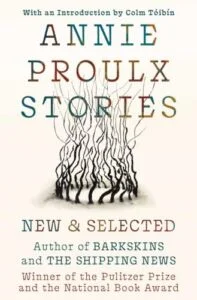
Dwight Garner describes Proulx as a writer who keeps adding: her prose crowds the page with odd details and grim scenes. Her new career-spanning collection,
Stories: New & Selected, ranges through accidents, deaths, injuries, fires and murders. The sheer volume of catastrophe can make the stories sound absurd. Garner’s point is that the overload has purpose. Proulx draws a rough, strange poetry from it.
Her crowded style also resists the sleek comforts of modern life. In these stories, new money arrives in old ranch country, where doctors turn ranches into weekend homes. Garner reaches for comparisons as varied as James Joyce, Gustav Klimt and Charles Ives to describe Proulx’s accumulation of language. His verdict is pointed: where Stephen King once compared his fiction to a Big Mac and fries, Proulx’s work is more like a platter of gizzards, chicken feet and deviled kidneys.
The image is deliberately unappetizing. That’s part of the argument: Proulx doesn’t smooth the world down for readers.
—Dwight Garner on Annie Proulx’s
Stories: New & Selected (
The New York Times)
Louise Kennedy follows the past into new lives
[](https://bookshop.org/a/40/9780593714607)
Clare Clark reads Louise Kennedy’s
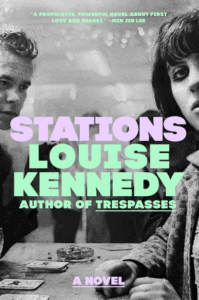
Stations as a love story shaped by the damage people carry with them. The novel follows a relationship across 25 years through dated entries separated by long gaps, a structure that recalls David Nicholls’s
One Day. But Kennedy’s 1980s London is harsher: squats, gas heaters and payphones, among Irish émigrés marked by poverty, violence, addiction, shame and loss.
Kennedy lived in London as a young woman, and Clark praises the precision with which she evokes the city. Her greater strength, though, is the care she brings to characters who are funny, generous and vulnerable alongside their self-destructive streaks. Róisín changes with age, but never becomes someone else. Clark finds that constancy convincing.
The title points both to the movement of migration—by train, boat and coach—and to the Catholic Stations of the Cross. Kennedy’s novel asks whether love can break cycles of anguish and neglect. It leaves the answer open, and lets the questions do their work.
—Clare Clark on Louise Kennedy’s
Stations (
The Guardian)
William Gass makes the reader live inside a mind
[](https://bookshop.org/a/40/9781628976366)
John Semly’s account of William Gass’s
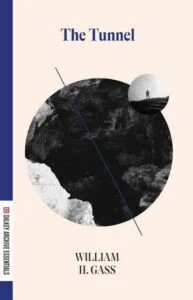
The Tunnel starts with a practical obstacle: the novel spent years out of print, with used copies fetching hundreds of dollars. Dalkey Archive has reissued it in full color, as Gass intended, alongside
The Tunnel Reader. The republication gives readers another way into a book that is both forbidding and hard to classify.
Its central figure, Kohler, digs a tunnel beneath his basement office and hides the soil in his wife’s antique wardrobes. The act might be an escape, a kind of self-burial, or simply an expression of desperation. Semly doesn’t claim the image has one clear meaning. Its cramped, filthy physicality mirrors the novel’s descent into Kohler’s psychology.
Gass’s subject is the formation of authoritarian resentment—what he calls “the fascism of the heart.” Kohler’s consciousness supplies the book’s entire world, making the usual label of “unreliable narrator” feel inadequate: there’s no external account to set against his. The result is a long, abrasive work that uses grotesque jokes, diagrams, limericks and dark fantasy to confront an ugly mind.
—John Semly on William Gass’s
The Tunnel (
The Nation)
Tom Drury maps a generous small world
[](https://bookshop.org/a/40/9780802168399)
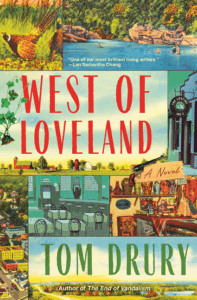
Daniel Mason finds a useful parallel between William Faulkner’s Yoknapatawpha County and the fictional Grouse County in Tom Drury’s
West of Loveland. Drury opens with a map marked by roads, towns and eccentric landmarks—the Swedish House, the Earring, the Gates of Hell, the Gun. It’s part guide and part puzzle, fitting for a novel built from lives that cross and overlap.
The cast is broad, but Mason says Drury’s patient attention keeps it manageable. Readers encounter familiar routines: conversations, modest meals, caring for the sick, staffing a thrift shop, taking down a silo. The novel belongs to a series, yet Mason finds it satisfying on its own.
What makes the book stand out is its faith in ordinary decency. Mason wonders whether Grouse County’s goodness describes people as they are or as they might become. The map may offer more than orientation; it suggests a path toward tolerance and civic involvement. Drury’s quieter virtues won’t suit every reader, but they make a clear case for fiction that doesn’t treat evil as the final word.
—Daniel Mason on Tom Drury’s
West of Loveland (
The New York Times)
William T. Vollmann turns the CIA into a workplace comedy
[](https://bookshop.org/a/40/9781648211881)
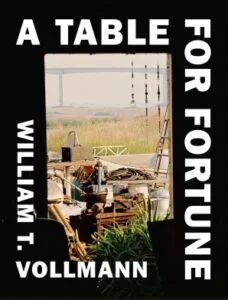
William T. Vollmann’s
A Table for Fortune runs to 3,000 pages across four volumes, the outcome of 15 years’ work. Nick Holdstock frames it as a reckoning with the American story: a family history and an insider’s account of the CIA, examining the costs of liberty and belief in American exceptionalism.
Vollmann’s sharpest move is to tell parts of that story as office comedy. The CIA speaks in its own institutional voice, full of acronyms, codenames and jargon, while treating death and suffering with sardonic humor. That tone gives the novel room to cover subjects from the Angolan civil war to Stasi interrogation methods—and to expose the agency’s double standards.
The length is easier to defend when the book follows the United States’ gradual entanglement in conflicts it can’t win, detail by detail. Yet the humor grows more bitter in the final volume. Holdstock sees a sorrowful portrait of a country still wrestling with the tension between personal freedom and state power. The book offers many opinions, but no final answer.
—Nick Holdstock on William T. Vollmann’s
A Table for Fortune (
The Guardian)