Luke Kennard’s Black Bag suggests that the troubles often described as a crisis of masculinity may have a more ordinary source: insecure work. Its unnamed narrator is a 37-year-old London actor who can’t pay his rent. When he gets a job sitting silently in university lectures inside a zipped leather bag, the absurd assignment gives him something more valuable than status: reliable income and a reason to feel useful.
That premise makes the novel an unexpectedly sharp argument about labor. The narrator’s isolation matters, but his life changes when he has work he can count on. My read is that the book’s central question isn’t what men have lost about being men. It’s what happens when people lose steady work, decent pay and a sense that their time has value.
A job inside the bag
The narrator takes the unusual assignment after months without paid acting work. He’s behind on rent and most of his utility bills, and describes his finances this way: “I have measured out my life in coffees I cannot technically afford.” Dr. Blend, a university professor, hires him to sit at the back of lectures, zipped into a black leather bag for a term. The arrangement is demeaning and strange. It also gives the actor “a level of fiscal security I have never experienced in adult life.” He’s not just relieved; he’s eager to do the job well.
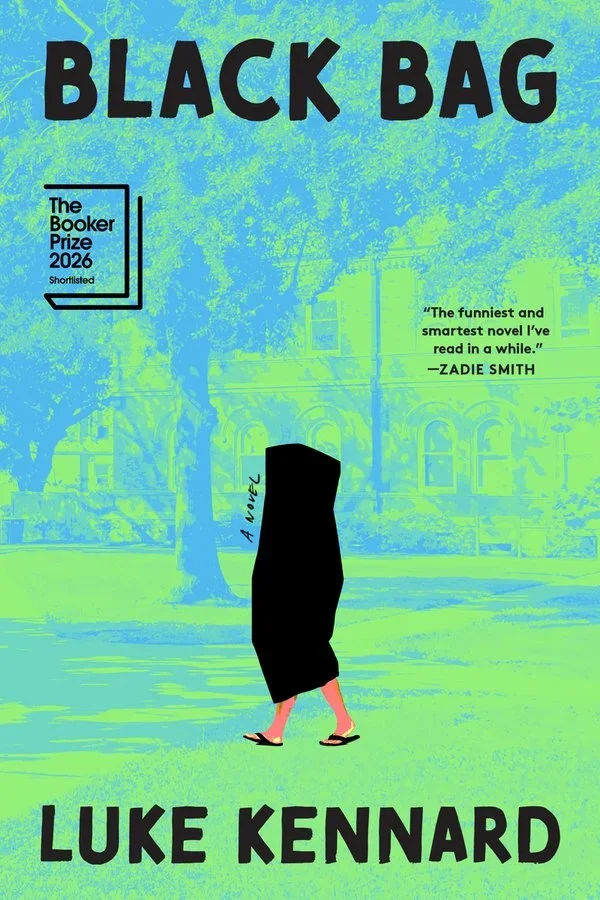
Work soon becomes part of how he understands himself. On days off, he climbs back into the bag and takes it around London, on buses and into cafés. “I would just as soon be black bag than whatever my self is,” he says. Without it, he sees himself as “some pitiful and unremarkable man going around, doing things.” The role is ridiculous, but the routine gives shape to days that had been defined by financial anxiety.
His private fantasies are modest, too. He imagines living in an isolated Swedish town and working at a sawmill, with “my superiors” supportive and gently amused while he learns. The dream isn’t fame or wealth. It’s a decent manager and a chance to get the hang of a job. Kennard makes that longing funny, but the joke lands because the need is real. The novel finds dignity in showing up, even when the work itself is absurd.
Black Bag is also a portrait of loneliness. The actor struggles to express affection to his parents, observing that “English people have such a deep-seated suspicion of disingenuousness that we often forego gratitude altogether.” He feels disconnected from other people and unsure how to say what he means. But his isolation doesn’t make the book only a story about men’s emotional lives. His economic precarity is woven through it.
Black Bag is more than a discourse on our forlorn men. It’s the most pro-labor novel of the year.
Why the masculinity frame misses something
Publishers, reviewers and Booker judges have presented the novel as a study of modern masculinity. That description isn’t baseless: its main character is a lonely man, and the book pays close attention to his sense of failure. But “crisis of masculinity” is a more attention-grabbing label than “can’t afford rent.” It can also redirect a conversation about material conditions toward arguments over gender roles.
That shift is visible in American political debate. Some prominent proposals define men’s problems through traditional family structures, restrictions on women’s choices and rigid ideas about who counts as masculine. JD Vance has proposed $9,000 per child for married couples only. The Heritage Foundation has urged RFK Jr. to target birth control pills, invoking claims about estrogen in the water and male fish becoming “girly.” In his book Manhood, Josh Hawley prescribes Bible study, early marriage and abstention from porn and video games. Secretary of War Pete Hegseth has declared, “We are leaving wokeness and weakness behind. No more pronouns. No more climate change obsession. No more emergency vaccine mandates. No more dudes in dresses, we’re done with that shit.”
These ideas treat masculinity as a fixed resource that other groups have supposedly taken away. They also make individual men responsible for resolving problems that may have little to do with gender. The actor in Kennard’s novel doesn’t need to marry sooner, pray more or check his testosterone. What he needs is work that pays reliably.
Very few of my needs are specific to my gender.
That’s not a claim that people have identical needs, or that gender never shapes anyone’s experience. It’s a reminder that many basic needs cross those lines. People need food, health care, housing and care for their children. Reducing a person’s troubles to their demographic identity can obscure shared economic pressures—and make it easier for powerful people to avoid addressing them.
The labor figures in the source of this debate give that concern a concrete scale. In 1983, one in four working men belonged to a union; today, it’s one in ten. The Economic Policy Institute estimates that NAFTA had cost the U.S. nearly 700,000 jobs by 2010, most in manufacturing, a sector that is 71 percent male. Tariffs have not brought factory work back as promised. Meanwhile, Anthropic CEO Dario Amodei told Axios that AI could push unemployment as high as 20 percent. The prospect of technological job loss adds to an already unsettled picture of work.
As the narrator puts it, “a life of quiet desperation is an impossible dream for my generation . . . We’d love nothing more than affordable accommodation to fail in.” Later, he includes being broke among the reasons he doesn’t feel like a man. That association is telling: a lack of income becomes a judgment about masculinity, even when the more direct explanation is a lack of secure work.
Why is joblessness related to testosterone, rather than a late-stage capitalist world order?
What better work would change
People of every gender are affected by unstable jobs, but men belong in that discussion too. The narrator’s relief at getting even an unconventional role shows how much a steady paycheck can change his sense of himself. He’s still the same person, with the same awkwardness and loneliness. But a job gives him structure, income and a place to put his effort.
That experience points toward a more useful conversation about what workers need: job protection, fair compensation and work that feels valued. The familiar complaint that “nobody wants to work anymore” has circulated for generations. People have good reason to avoid jobs that pay poorly, offer no path forward, tie health insurance to employment and can disappear without warning. Unions are one way workers can defend the value and stability of their work.
A masculinity frame can make those questions seem secondary, while offering personal behavior as the remedy. A labor frame asks who sets wages, who owns workplaces and who bears the cost when jobs vanish. It also points toward changes that could help people beyond any one group, including stronger worker protections and higher minimum wages.
A discussion of men’s isolation is worthwhile, and Kennard writes sensitively about it. But the book’s force comes from connecting that isolation to everyday insecurity. The narrator’s crisis lifts when he gets a job he can depend on, not when he adopts a prescribed version of manhood. Black Bag makes a persuasive case that the search for a masculinity cure can distract from a more widely shared problem: too many people can’t find stable, meaningful work that pays enough to live on.
The question the novel leaves hanging is practical. If reliable work can restore a person’s sense of purpose, then the health of that work matters. Better wages and stronger job protections won’t answer every question about loneliness, but they would give more people a firmer place to stand.


