Harry Crews taught me that a song can look foolish on the page and still be worth singing. His novels are full of grotesque behavior, wild language and people who seem too strange to be real. But beneath the excess, he kept finding tenderness. That combination mattered to me while I was writing Boat Songs, and it still shapes how I think about making art.

MJ Lenderman. Photograph by Sol Procter-Tarabanov. CC BY-SA 4.0, via Wikimedia Commons.
Finding Crews in Asheville
I first heard about Crews from a friend when I was a teenager in Asheville, North Carolina. We’d sit on the front porch of his house behind a grocery store, staying up late and trying to write songs. Usually, we spent more time drinking and talking about writers than actually writing. One night, my friend told me about Harry Crews and A Feast of Snakes, his mid-seventies novel set in Mystic, Georgia. He described Crews as “this fucked-up guy.” That was enough to get my attention.
The Knockout Artist made me want to read more. Its central character, Eugene Talmadge Biggs, is a kid who knocks himself unconscious for paying spectators. The morning after I heard about the book, I ordered it along with A Feast of Snakes and a collection that included Crews’s memoir, A Childhood, and the novels The Gypsy’s Curse and Car.
I was caught quickly by Crews’s dialogue: it sounded lived in, and his Southern settings felt vivid without resembling anything I’d seen exactly. His books gave me a bent reflection of home. I could imagine their characters turning up around people I knew, including Gary King, my landlord at the time.
Gary owned the Haw Creek property where I lived with friends and bandmates. It was a cluster of houses, more a compound than a band house, where we worked, lived and barbecued. Gary would tell dirty limericks in his kitchen and smoke Pall Mall Blues while connected to oxygen. Sometimes he’d park outside our place and lean on the horn until we came out to talk. He treated us like grandchildren and never raised the rent. Crews’s characters weren’t copies of people like Gary, but the distance between his fiction and the odd, affectionate life around me didn’t feel very wide.
Writing through uncertainty
The pandemic soon sent me home, where I spent my days reading, playing music and writing. It became the most focused and formative stretch of songwriting I’d had to that point, and Crews was part of it. My girlfriend then, Karly Hartzman, who was also my bandmate in Wednesday, gave me several of his books I hadn’t read, including signed copies. I also found an index of his interviews and began treating them as a kind of guide to writing songs.
Crews had been born to tenant farmers in Bacon County, Georgia. That place name sounds invented for one of his novels, except it was real. He taught himself, began without many advantages and had to keep working when no one was paying attention. In interviews, he spoke about the ability to withstand failure as part of any artistic pursuit. I needed to hear that. Crews could come across as a hard-ass, but the thought underneath was open and generous: you have to put the idea on the page before you can judge whether it works.
That was the period when I was writing the songs that became Boat Songs, the album that brought my music to listeners beyond Asheville. I could see how the songs might seem silly written down, but they felt right to me. Crews also described writing as an act of courage. Singing those songs asked for a version of that courage. His advice helped me make the record, and I still return to it.
His language was another lesson. Crews could make a phrase ridiculous, precise and serious at once. In his books, someone is always “hustling his balls.” Those three words could support an essay of their own. I started looking for phrases with that kind of charge, and sometimes I borrowed directly from him.
A line from Crews in “Joker Lips”
People often quote a line from “Joker Lips,” a song on Manning Fireworks: “Every Catholic knows he could have been Pope.” I didn’t come up with it. Crews did. In the 1968 first edition of Gospel Singer, published by William Morrow & Company, the line appears on page 209. The passage continues: “Every man knows that his gift will set him free if he is just lucky enough. Or unlucky enough, depending upon your point of view.”
That last thought fits the way Crews writes about ambition: a person’s gift can bring freedom, but it can also bring trouble. The tension is everywhere in Body, a book that appears to center on a bodybuilding rivalry between Shereel Dupont and Marvella Washington. Marvella is a powerful Black woman from Detroit. Shereel, a small, sculpted white woman from Waycross, Georgia, was once named Dorothy Turnipseed.
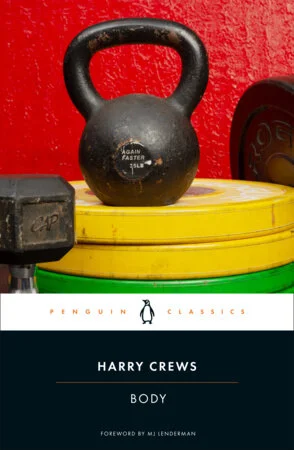
The women’s competition is only part of the story. The deeper contest belongs to their aging coaches, Russell “Muscle” Morgan and Wallace “The Wall” Wilson. Both men are still huge, but they’ve run out of ways to win except by controlling the women they train. Muscle’s grip on Shereel is especially severe: he renames her, controls her water, keeps her away from her family and dictates when she has sex with him. She wanted to work as his secretary. He insists on turning her into Ms. Cosmos.
The tenderness beneath the absurdity
Body pushes every name, action and figure so far that the novel can feel like caricature. That extremity is also how Crews gets close to his characters. He finds gentleness inside people built up to seem monstrous. Nail Head, for instance, turns out to be capable of deep affection. Billy Bat, an extraordinary bodybuilder, finds the family and romance he didn’t know he wanted with Shereel’s sister, Earline, whose appetite for food is so strong she carries spare fried chicken.
The bodybuilding show at the Blue Flamingo is a comic disaster. Still, Crews gives the mess a heart. His people are ridiculous, but he doesn’t leave them at the level of the joke.
Readers should know what they’re getting into. Like much of Crews’s work, Body contains brutal material. Muscle and the Wall trade racist slurs across their rivalry, and the book depicts sexual encounters in which women have little or no say. It opens with a violent sexual scene that leaves hotel furniture broken. The hotel manager, a man so ashamed of his toupee that he won’t sleep with a woman who might see him without it, cycles through secretaries he calls “Miss Beverly” and demands oral sex from beneath his desk.
Crews uses ugliness like a harsh spotlight. The colors can be garish, but the effect is to make readers look at the kinds of behavior people are capable of, rather than smoothing them into something easier to accept.
I won’t give away the ending of Body, though its final three pages deserve mention. Crews is often associated with exaggeration, with blowing up the chaos people create. The close of this novel works through restraint instead. Its reveal is so finely judged that I had to read it more than once to understand it. On later visits, I noticed clues he’d placed earlier, small details that make the ending feel earned.
Following those clues has made me a better reader and writer, but it’s also changed how I regard people. Their choices can look bizarre from the outside. Crews keeps asking us to look again, long enough to see that most people are trying to do the best they can. That’s a difficult kindness, and one worth carrying into whatever we make next.
MJ Lenderman was born and raised in Asheville, North Carolina, and is a singer-songwriter and multi-instrumentalist. His albums include Boat Songs (2022) and Manning Fireworks (2024).
Adapted from the foreword to Harry Crews’s Body, to be published by Penguin Classics on November 10.