All photographs courtesy of Jean Garnett.
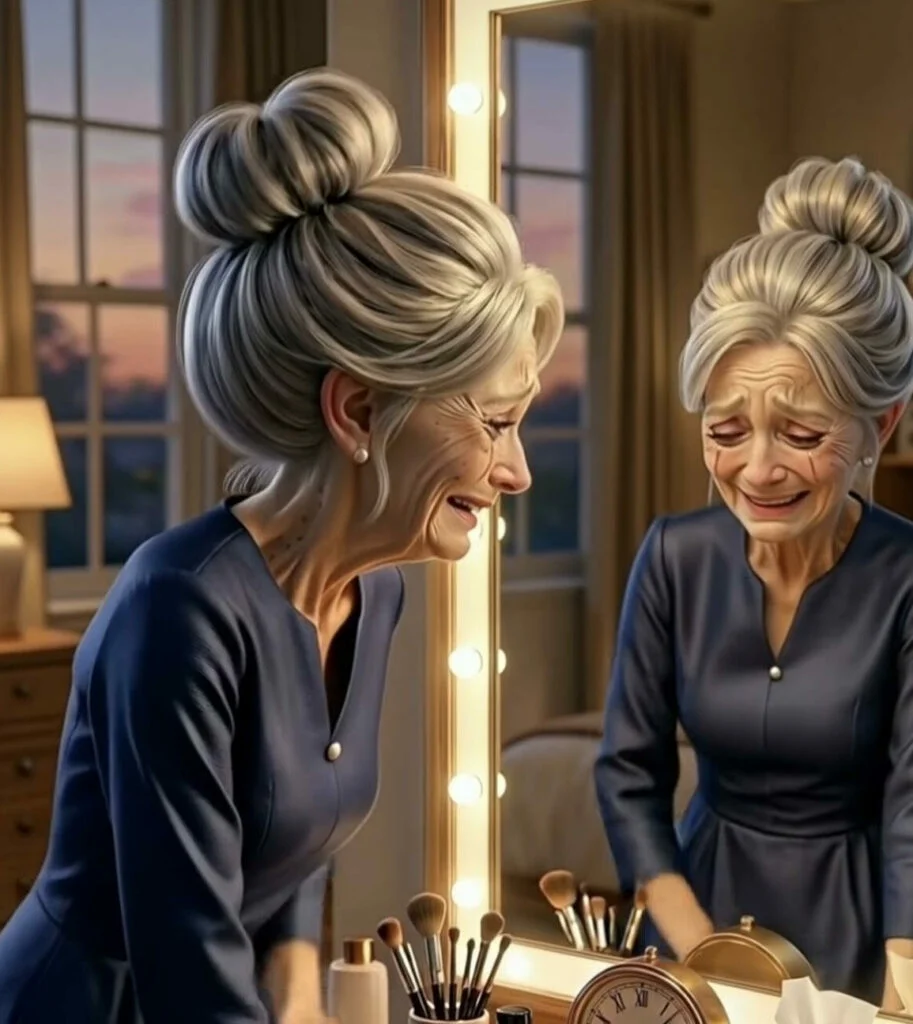
The tears give the ad away before the product does. They bead in a woman’s wide, frightened eyes, then hang from them in clear strings instead of running down her cheeks. It’s an image so wrong that it catches the thumb mid-scroll.
The woman is rendered in the rounded, oversized style of an animated character, folded into a cubicle as she cries. In other versions, the same distress plays out in a bathroom, a car, at a child’s soccer game or a rehearsal dinner. The plot barely changes: she’s getting older, and her husband is losing interest. He says she “used to light up” and doesn’t “look like yourself anymore.” He tells a friend she has “let herself go.” Sometimes he has already left for someone younger; sometimes he’s having an affair with a colleague who hasn’t let herself go.
These ads cast age as a problem that can be removed, then offer a product to do the removing. The rescue may come from a sister or colleague returning from Seoul, a friend who works there, or a daughter watching her father leave with a younger girlfriend. The daughter reaches for a hydrating gel mask, serum or nonoxidizing foundation to “save face”—her mother’s in the literal sense, her own in the figurative one.
I’ve started thinking of this fast-spreading Instagram Reels genre as “Purification Slop”: AI-made marketing that turns vague discomfort into something supposedly trapped inside the body and ready to be extracted. The fantasy isn’t limited to skincare. It’s also the mushroom drink whose probiotics supposedly sweep the intestines clean, or a jade roller that promises to drain lymphatic fluid. The pitch meets a private hope: that whatever feels wrong—including age—can be isolated and flushed away. And the algorithm seems to know that mirrors can be difficult, depending on the light and the day.
Soap opera, with a sales pitch
These are infomercials dressed up as emotional dramas, some running longer than ten minutes. Their songs move from intimate confession to a swelling chorus, often in the style of Taylor Swift or Olivia Rodrigo. The opening line is designed to hurt: “This is the story of the day he walked away.” Or: “My ex-husband walked in with the woman he left me for, young enough to be our daughter.” One Black woman begins, “I ran into my baby daddy at daycare drop-off with the bitch he left me for.”
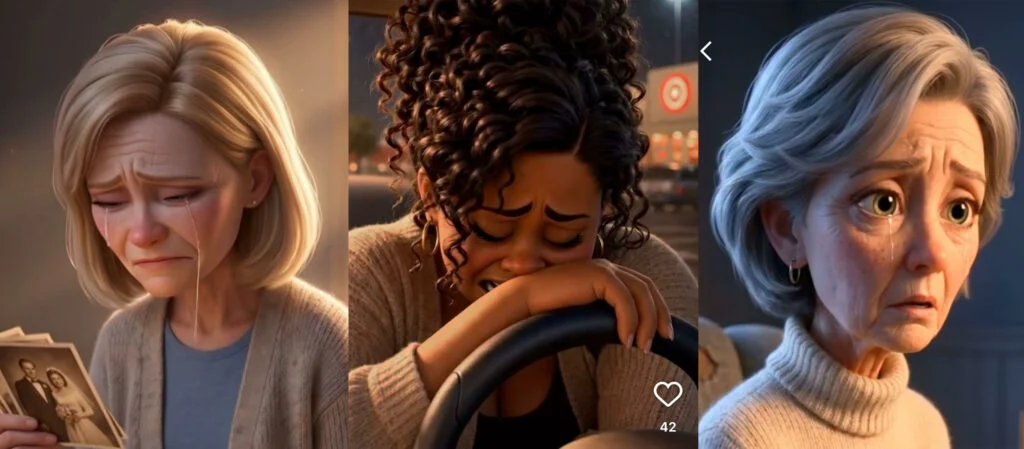
Age carries a strange double meaning in these stories. When I was twenty, a fashionable restaurateur paid me to make new mahogany tables look decades old: I battered them with chains and chisels, then sanded, stained and scraped the wood until it seemed to have a past. That worn finish gave a new bistro the feeling of intimacy and history. Men in these ads get a similar treatment from time itself. Gray hair, drier skin, even the supposed freedom of losing a wife and children can read as authority, vitality and value. Women, by contrast, are framed as having failed. After several of these videos, the question becomes hard to ignore: how can a man’s age signify experience while a woman’s makes her disposable?
Susan Sontag called this the “double standard of aging.” The standard is old; the new wrinkle is that AI can now perform emotional intimacy well enough to sell through it. For years, marketers assumed people often distrusted algorithmic recommendations, even when those recommendations could outperform human judgment in some settings, including certain medical diagnoses. In 2020, marketing researchers Chiara Longoni and Luca Cian described a “word-of-machine” effect: trust in AI recommendations depends on what someone wants. People seeking a clear practical outcome, such as dental floss, may favor an algorithm. For experiences tied to sensation or feeling, like a horror movie, they tend to prefer a human recommendation.
That distinction has shaped marketing since researchers brought the “hedonic viewpoint” into the field in the 1980s. It helped explain why people sometimes choose media precisely because it makes them feel bad. The approach treats consumers as people seeking emotional release, not simply as buyers evaluating a product. By 2026, AI appears to have crossed into that territory, or at least learned to imitate it with unnerving fluency. Can a machine sell a feeling? These ads suggest it can—even when its mistakes make the machine visible.
The appeal of the obvious fake
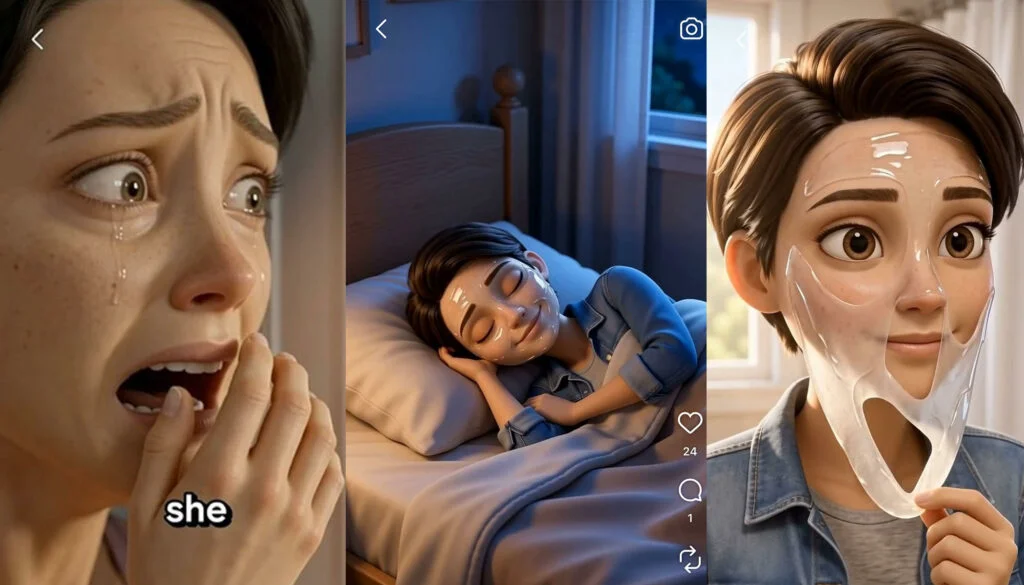
American “K-beauty” brands such as Quasi, Yuri and Koriderm run many of these Aging Woman Emomercials, or AWEs. They don’t disclose that the ads are AI-generated, as New York State law now requires. The videos give the game away anyway: mismatched lip movements, outfits that change between shots, awkward edits, glue-like tears and dialogue that slips into nonsense. One woman is “fifty-three-forty” years old; another says competing moisturizers “evaporate like glass.” The errors create distance between the companies and their ads, a convenient shield when the scripts go as low as asking, “How can I be loved when I look like this?”
Here’s the unsettling part: recognizing the fakery doesn’t necessarily make me immune to it. I don’t respond to an AWE quite as I would to a human-made ad designed to manipulate me. It feels more like a jumble of cultural whispers, a child repeating what adults have said. With no obvious person behind the performance, I find myself less guarded against its emotional pressure. The “word-of-machine” effect seems to run backward.
The women in these ads are in far worse shape than the mildly frazzled wives or softly worried patients familiar from television commercials. They’re collapsing into panic, sobbing on the floor, withdrawing from friends, disgusted by their own bodies. One considers skipping her daughter’s wedding because she can’t bear to be seen. The premise is lurid, but the despair feels recognizable.
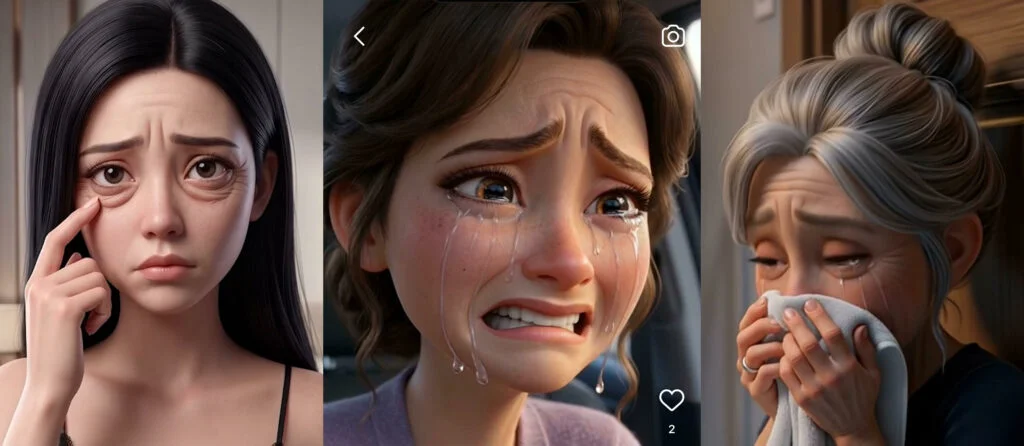
That combination—hard-edged gender rules and a midlife breakdown—gives the videos a cathartic force I didn’t expect from an ad. Women learn early that getting older can mean becoming socially invisible. We’ve absorbed that message for years, and may have mistaken familiarity for acceptance. These miniature dramas make the old assumption feel newly raw: a woman’s changing face becomes a personal tragedy unfolding in real time.
Many women I know, including those who understand the pressure intellectually, sometimes fall apart over their changing faces. Knowing better can add guilt to the anxiety. The AI ads give blunt voice to feelings that polite, ethically minded people may hesitate to say aloud. Their claims are hackneyed, but the recognition can still land. The product’s promised effect is to make you feel seen. One woman, after sleeping in a collagen mask, sings: “The moment was me alone in that mirror finally seeing myself clearly.”
The reunion the story is selling
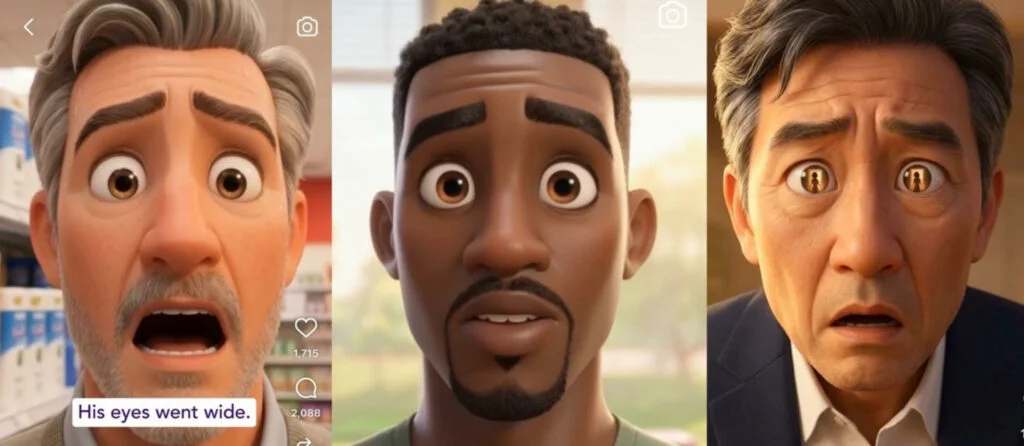
The ads say their heroines are reclaiming confidence and recognizing themselves again. Yet the emotional payoff usually arrives when the woman encounters the man who left her. Now her face is smooth and full, and he stares, mouth open, at the transformation. He expected to find the “old broken face”; instead, there’s a “radiant woman standing tall.” For a few seconds, the man’s stunned expression turns him into a cartoon. Then the heroine insists she doesn’t want him back and steers the story toward “buy now while supplies last.”
I had my own encounter with an ex, two years after he left. I was walking alone through the dunes at a New York City beach, hurrying toward the exit as dark clouds rolled in, when I saw him ahead with a woman close enough to brush arms. I said hello. He and his companion turned without much reaction, and I wondered if they had spotted me earlier and tried to avoid me.
At the opening in the chain-link fence, the woman stepped aside while he knelt to put on his shoes. She was tall, muscular and seemed at least ten years younger than me. I waved; she gave me a strained smile. He appeared to apologize, explaining that he was distracted because he’d recently watched a video of someone being struck by lightning and feared the same thing might happen as the storm approached. In that moment, his fear seemed perfectly reasonable.
Then the encounter lurched into the awkwardness of a dream. I started apologizing for making them uncomfortable and walked away, only to turn back and shout, “Peace!” He jogged after me because he hadn’t heard. “It doesn’t have to be weird,” I said, almost singing it. He introduced us. We walked together across the field toward the clouds, and I felt absurdly grateful when his companion recognized the place I was going that evening. She pointed out his untied shoes. Then she said she had to use the restroom and headed toward the low concrete building. He stopped; I kept walking. Rain began—first a few cold drops, then a downpour—and I ran to my car, soaked through.
We want the people who left us to see what we’ve become. We tell ourselves that love made us better, and losing it made us stronger still. I keep being surprised by how much more alive I feel as I age. To look tired or diminished on the outside can feel like a betrayal of that inner life, as if caring about appearance deserves punishment.
We’re also told that AI itself is becoming more alive and autonomous. The warnings about recursive self-improvement imagine a system that could gain agency and turn against us. In that story, the machine might resemble the underestimated ex-wife from the ads: newly powerful, and done being watched ironically. “This is what you get,” it says, “for thinking you could watch me ironically.”
A mask kept for later
My daughter sees the pink box in my hands. Its logo reminds her of the killer’s mask in Scream. “What is that?” she asks.
“It’s just something for my face,” I tell her, “to make my skin better.”
She tells me not to use it. When an ad interrupts something we’re streaming, she often explains the problem the ad has invented so it can sell us a solution. Now she sounds truly worried. I think about how frightening it would be if the mask worked as promised and made me look unfamiliar to her.
“You’re right,” I say. “You’re so smart. I shouldn’t have bought it. I won’t use it.” I carry the box away as if I’m going to throw it out, then tuck it under a pile of books in my bedroom for a night when she’s at her father’s.
Jean Garnett is a writer and editor whose work has appeared in The New Yorker, The New York Times Magazine, The Yale Review and The Paris Review. Her first book, The Tantrum, is scheduled for publication by Scribner in April 2027.


