What My Job Is Like as a Fact Checker at Bon Appétit
Publishing a magazine, website, app, YouTube channel, and more takes a lot of people. Bon Appétit research director Ryan Harrington explains how his team checks stories and recipes—and why the job sometimes means tracking down a long-forgotten bar or deciding whether a hot dog counts as a sandwich.
For readers outside journalism: What does research and fact-checking involve?
At Bon Appétit, stories and recipes go through several rounds of editing before they reach the research team. Our job is to make sure the details hold up: names and brands are spelled correctly, restaurant menus and dishes are described accurately, sources are credible, and quotes represent the people who said them.
That work also means asking whose perspective a story reflects. Food media has often treated unfamiliar cuisines as discoveries and made other cultures seem exotic. Research can help catch that framing and make room for people to speak about their own experiences without turning them into a spectacle.
There’s a legal side, too. We work between editors and the legal team, flagging possible libel, copyright, food safety, and source protection issues. The point is simple: readers should be able to trust what they’re reading, and editors should know when a story needs a closer look.
How did you become a fact checker, and what did you do before Bon Appétit?
I studied chemistry as an undergraduate, then spent six years running operations at a thoracic surgery lab focused on forms of lung cancer. When I was asked to pursue a master’s degree or PhD, I realized I wanted to spend that time studying food media instead.
I enrolled in NYU’s Food Studies master’s program to examine the cultural effects of food media. An internship at Food & Wine led to other assignments, and I began to see the field as a career as well as an academic subject. I later worked at Travel + Leisure and Lucky Peach.
I also tried working at a brewery, starting in February 2020. The pandemic made that a rough moment to enter the industry, though it gave me a close view of its effects. When Bon Appétit’s research director role opened, my science and food media experience seemed like a good fit. I’ve been here five years.
You teach food studies at NYU. How does that shape your work at Bon Appétit?
Whether I’m planning a class or reviewing a story, I try to see it from the audience’s point of view. Is the idea clear? What will students or readers take away? Helping someone reach that moment when an idea clicks is what I enjoy about both jobs.
You started a research fellowship at Bon Appétit. What do fellows get to do?
An internship gave me my first foothold in media. I didn’t have formal journalism training, but the experience helped me build skills and connections. When I joined Bon Appétit, I wanted to offer that kind of opening to other people who care about food.
Fellows learn research editing while making room for their own interests. Some work with the Test Kitchen on recipe development and editing; others pitch and publish stories or learn how the photo team styles recipes for shoots. Each person has different goals, and I want the fellowship to help them pursue those goals.
Which stories are your favorites to work on, and which are hardest?
I grew up watching Alton Brown’s Good Eats, and I’ve always wanted to understand not just how cooking works, but why. Stories that explain a process suit the scientist in me. One example is a video about Dr. Arielle Johnson making a chocolate bar. Arielle and I were chemistry lab partners in our first year at NYU, which makes the project especially fun.
Wine stories are tougher. The terminology is precise, rules vary across countries, and names often include diacritics that are easy to get wrong. I’ve built a network of knowledgeable wine experts I can call when questions come up.
What’s the most amusing research rabbit hole you’ve followed?
In 2021, Bon Appétit published a story about Moe Girton and her bar, Gossip Grill. Girton talked about San Diego’s lesbian bar scene when she moved there in the late 1990s. The story’s author left me a note: “note to fact-checkers to verify the names [of these bars].”
Two of the three bars were easy to confirm. The third had almost no online record, so I searched newspaper archives, community forums, and old message boards. The clues didn’t always agree, and I eventually asked Girton for more help. She recalled the cross streets, so I called businesses in the area one by one, asking whether they’d been there in the late ’90s and remembered a nearby lesbian bar.
That unlikely search led me to the owner of George’s Camera, a photography shop that has operated since 1965. He said Patti’s Bar used to be next door, describing it as a “lesbian and biker friendly bar.” He even had a photo of the storefront, signs included. Sometimes the best archive is a person who was there.
Which Bon Appétit recipe do you make most?
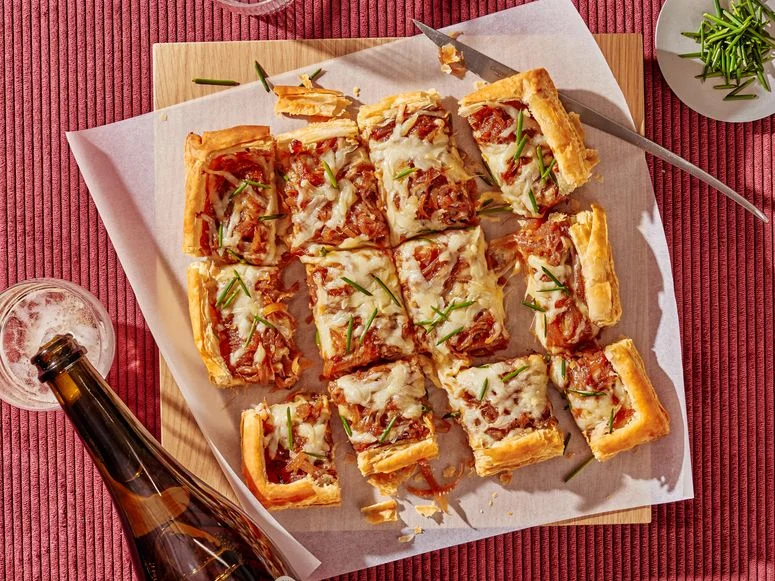
I love Shilpa Uskokovic’s French Onion Tart. It looks like a lot of work and impresses guests, but it mostly takes care of itself while I do something else. The effort-to-deliciousness ratio is excellent. The box has two sheets of puff pastry, too: one for company and one for breakfast the next morning.
What’s your favorite obscure food trivia?
I’ve spent plenty of time arguing about what qualifies as a sandwich. New York’s tax guidance takes a broad view: the state Department of Taxation and Finance generally treats sandwiches as taxable, and its examples include a hot dog, a burrito, and even a buttered bagel.
Massachusetts drew a firmer line in 2006. When Qdoba planned to open at White City Shopping Center, Panera argued that a lease clause barred competing sandwich shops. After hearing expert testimony, Judge Jeffrey Locke ruled that a burrito wasn’t a sandwich, clearing Qdoba to open. The Worcester Superior Court decision may not settle the debate, but it did settle that lease dispute.
Maybe there’s no universal answer. Maybe the sandwich was the friends we made along the way.
Could you win on Jeopardy?
The best part of this job is that I don’t have to know everything. I have to know how to find someone who does. I doubt Ken Jennings would let me Google during filming, though.
How does AI intersect with or influence your current work?
AI’s strongest case here is practical, not sweeping. It can save hours on routine work, but its output still needs a human check. Early in my editorial career, I transcribed reporters’ interviews by hand; an hour of audio could take me two or three hours to finish. AI transcription has cut that time sharply. It still mishears things, so I follow along with the recording and correct the text. For now, that’s a useful trade: less time typing, with a person still responsible for accuracy.
What kitchen tool (or gadget or appliance) are you obsessed with right now?
My immersion blender earns its place in my small New York kitchen. It handles pasta sauce, soup, salsa, and smoothies without claiming a spot on the counter. Better yet, I can blend right in the pot, which means less mess and no precarious trip from pot to pitcher and back.
One more kitchen trick has proved its worth: chef Frank Proto’s method for squeezing citrus with tongs. I used it recently in a rental kitchen with very little equipment. We needed plenty of juice for marinades and margaritas, and the tongs made the job easier.
The movie or TV show you’d rewatch until the end of time?
Happy Endings is my answer. The ABC sitcom ran from 2011 to 2013, and its setup has shades of Seinfeld: friends trying to get through urban young adulthood while acutely aware of the social rules they’re supposed to follow. That self-consciousness gives the comedy its bite.
I once wrote an academic paper about how the show uses—and sometimes flips—the big eater trope to explore food and gender. Two characters of different genders and sexualities perform that role in different ways. The show suggests that social expectations can be arbitrary—and that acting against them can open up room for other people to do the same. It makes the point without losing its comic touch.
Also, it’s really fricking funny.
Make Ryan’s favorite recipe
Support our team’s journalism and browse thousands of Test Kitchen–vetted recipes by subscribing.


