Five reviews, five arguments about how people live under pressure
The sharpest thread running through this week’s reviews is how people make lives inside systems that constrain them: digital media, history, labor, gender, and the pursuit of wealth. The books range widely, but none treats its subject as safely in the past or confined to fiction.
Junot Díaz reads Jane Schoenbrun’s
Public Access Afterworld as a genre-spanning reworking of Orpheus, rooted in the lives of marginalized characters. Kevin Power considers Yiyun Li’s
Music Against the Night and the limits of historical fiction. Sarah Chihaya turns to Deborah Lutz’s biography
This Dark Night, which leaves Emily Brontë partly unknowable. Anna Louie Sussman examines the labor politics of Sarah Anderson’s
Fallow. And Kathryn Schulz takes up Nathaniel Philbrick’s
The Rush, a history of California gold and the forces that helped shape the Civil War and the modern United States.
*
Jane Schoenbrun makes the uncanny personal
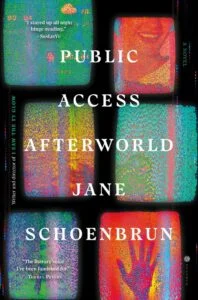
Díaz sees a debut novel that draws on an unusually broad set of influences without losing sight of its characters. Schoenbrun, known for films including
I Saw the TV Glow, recasts the Orpheus myth through conspiracy, urban fantasy, and neo-slave narrative, with echoes of
Videodrome,
The Matrix, and Neal Stephenson’s
Snow Crash. The mixture could easily become a catalogue of references. Díaz argues that it doesn’t: the story stays close to people whose daily lives give the fantastic its human stakes.
The novel’s characters are variously damaged, complicit, or afraid. Jules struggles with self-hatred and substance use; David fails to recognize the harm he causes; and Willa, in a separate 1940s Los Alamos storyline, lives with her scientist husband and is drawn to a newcomer, Rachel. Even a creature caught between dimensions, Díaz writes, becomes a source of emotional force.
His reading also places Bethany, a tormented survivor in a story of young women being hunted, within Carol Clover’s “final girl” tradition. The character survives as part of a community marked for destruction, but her scars teach her to recognize danger and confinement. Díaz’s larger point is that the novel’s answer to cruelty is not escape: it is the hard work of creativity, solidarity, laughter, and the possibility of love.
–Junot Díaz on Jane Schoenbrun’s Public Access Afterworld (The New York Times Book Review)
Yiyun Li asks what art can do with history
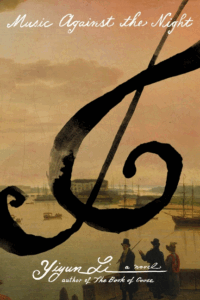
Kevin Power begins with a challenge to the historical novel’s staying power. Philip Hensher argues that books about the past tend to lose their place in literary culture as readers turn toward contemporary life. Power grants the possibility, but treats posterity as a poor guide to what readers should value now. Gore Vidal’s image of the future as “a permanent darkness where no whistle sounds” makes the point neatly: a book’s uncertain afterlife doesn’t settle what it can mean in the present.
That question runs through Li’s
Music Against the Night, though Power resists placing it in the familiar costume-drama category. He describes Li’s work as more interested in art itself and in what it can make of life than in period setting for its own sake.
The novel’s brief treatment of a child’s death carries particular weight given Li’s public writing about the suicides of her sons, Vincent and James. Power says the book doesn’t dwell on that loss. Instead, it sets the passions of living against art’s austere, indifferent standards. Its narrator suggests that death is easier for a lesser artist to write about than life. Li, in Power’s view, meets the harder test.
–Kevin Power on Yiyun Li’s Music Against the Night (The Guardian)
Emily Brontë stays partly beyond reach
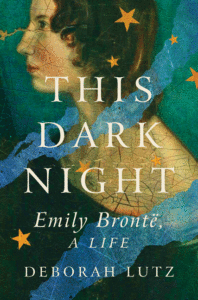
Chihaya admits she initially resisted reading another biography of Emily Brontë. Brontë’s distance from readers is part of her appeal, and Elizabeth Gaskell’s portrait of a woman most at ease on the moors helped shape the image of her as a stranger to ordinary life. Chihaya, who has read nearly all of Brontë’s surviving work, had little desire to turn that mystery into a tidy explanation.
Deborah Lutz’s
This Dark Night earns Chihaya’s approval by refusing to make Brontë easy to know. The biography raises questions instead of filling gaps with confident answers. That approach may frustrate readers looking for new facts about Brontë’s character, but Chihaya sees its restraint as the book’s strength.
The familiar “moor nymph” image owes much to Charlotte Brontë’s preface to the posthumous second edition of
Wuthering Heights, where grief and perhaps an inability to describe her sister helped cast Emily as a near-mythic figure. Lutz offers another route: she brings Brontë back to the particular environment that shaped her, without pretending that this makes her fully legible. Chihaya finishes the biography knowing more about Brontë’s world, while accepting that Brontë herself remains out of reach.
–Sarah Chihaya on Deborah Lutz’s This Dark Night: Emily Brontë, A Life (The Nation)
Fallow makes the politics of work concrete
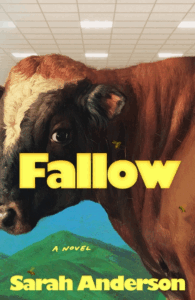
Sarah Anderson’s novel occupies an uneasy space between recognizable contemporary fiction and speculative warning. Its world is close enough to ours—shaped by surveillance technology and capitalism—to make the premise unsettling, without tipping into conventional science fiction. Sussman sees that near-future mode as especially useful to feminist writers, who can take existing political proposals and follow them into harsher consequences.
The novel’s focus on surrogacy complicates the usual dystopian picture of forced pregnancy. Anderson considers it as work within an already exploitative labor market and asks who holds the power in any given arrangement. Natalie’s experience changes as her relationships do: what begins as exploitation shifts toward respect and consent, and her understanding of work moves from accumulation toward interdependence.
Sussman connects that argument to feminist demands for wages for housework and compensation for the unpaid labor of “life-making”: pregnancy, caregiving, cooking, cleaning, and the work of sustaining families. The novel’s criticism lands on bosses and an economy that undervalues workers, she argues, rather than on Natalie’s choice of labor. That’s a more specific—and more difficult—claim than treating surrogacy as either simple empowerment or inevitable harm.
–Anna Louie Sussman on Sarah Anderson’s Fallow (The New Republic)
California’s gold rush becomes a story about speed and power
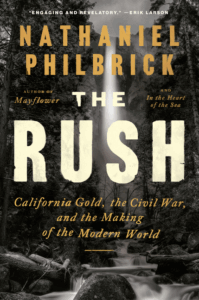
Schulz describes Nathaniel Philbrick’s
The Rush as sprawling, crowded with stories and arguments. Two claims organize the book: California’s gold discovery set off a contest for wealth, land, labor, and power that helped bring on the Civil War and influenced its outcome; and the gold itself mattered less than the speed and appetite the rush embodied.
Philbrick traces a distinctly American hunger for novelty and transformation through the forty-niners who abandoned their lives for the West. Schulz links that impulse to the planned Anthropic IPO, suggesting that the rush’s defining energy still shapes the country’s idea of its future.
Gold’s strongest lesson is about people, not prophecy
Nathaniel Philbrick’s *The Rush* reaches for two big explanations: that the California Gold Rush helped create the modern world, and that it revealed something distinctively American about the hunger for wealth. Kathryn Schulz isn’t persuaded. The parallels with today’s AI boom—early movers, fortunes built on infrastructure, political turmoil, environmental damage and widening inequality—are striking, but resemblance alone doesn’t establish cause. And the rush drew Australians, French, Chinese and Chileans alongside Americans, which makes the appetite for sudden riches hard to call uniquely national.
The book’s trouble, Schulz argues, is partly that these claims pull in different directions: one concerns historical cause and effect, the other psychology and culture. Philbrick’s account keeps opening onto a broader story of California from 1848 to 1878, a period vivid enough to stand on its own. That raises a better question than whether the Gold Rush made us what we are: does history have to explain the present to deserve our attention?
The gaps in the record—and the value of the story
Philbrick makes room for people often obscured in familiar accounts. More than 10,000 Chinese workers helped build the transcontinental railroad, yet no diary or letter from any of them has been found. That absence leaves a deep gap in the record of their lives in California. Schulz credits Philbrick for recognizing what the archive can hide, while arguing that the book is constrained more by the people and episodes it includes than by the ones missing.
Here’s the more convincing explanation for the Gold Rush’s echoes in the present: place people near the possibility of extraordinary wealth, and many will rush toward it, compete, cheat, boast, invent new ways to extract it, set rules, break them and try to control the prize. Philbrick is strongest when he follows that scramble through specific lives and decisions. The past may help us think about the present, but it doesn’t need to serve as its blueprint. Sometimes its value is simply in seeing it clearly.
–Kathryn Schulz on Nathaniel Philbrick’s The Rush: California Gold, the Civil War, and the Making of the Modern World (The New Yorker)


