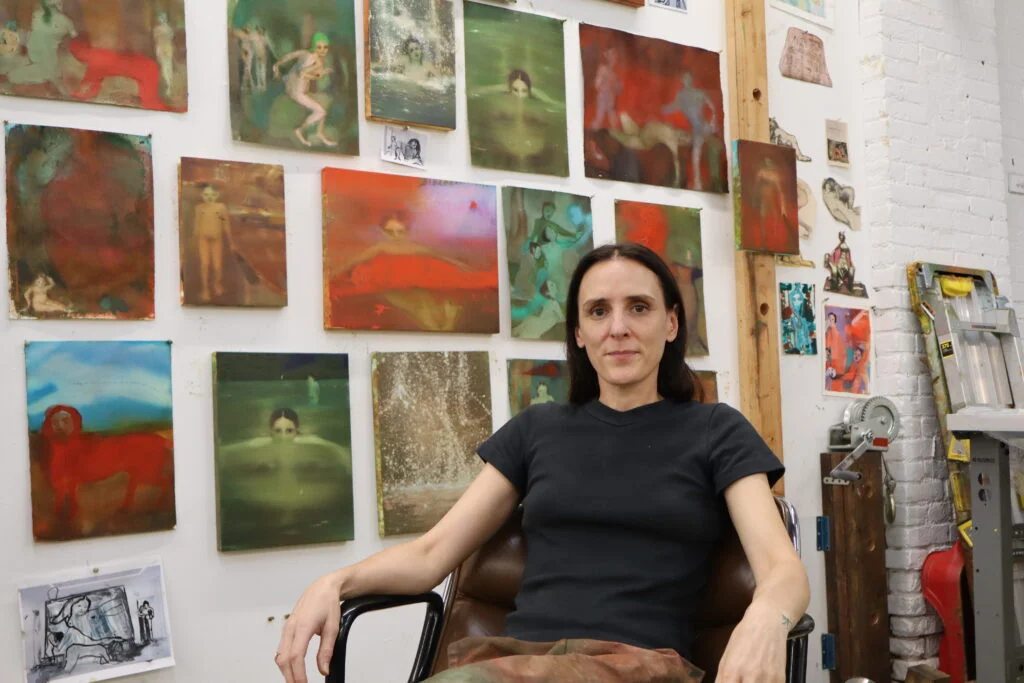
Elizabeth Glaessner in her studio in Brooklyn. Photograph by Hazel Byers.
A figure inside the image
Elizabeth Glaessner’s nearly seven-foot painting Big Head compresses a dense personal image into a scene that keeps changing its meaning. Featured on the cover of The Paris Review’s Fall issue, no. 257, the work began with a smaller figure emerging from a mouth—a drawing rooted in Glaessner’s childhood experiences of fear and religion. The scale makes the mouth difficult to treat as a mere background detail: it becomes a setting, an opening, and a presence that seems to organize the rest of the scene.
When The Paris Review visited the Brooklyn-based artist at her East Williamsburg studio in September, large canvases shared the space with smaller versions of recurring images. Glaessner often paints the same motifs repeatedly, sometimes bracing one hand against the wall and leaving colored prints nearby. In Big Head, a figure at the lower left paints the enormous mouth from which it once emerged. The arrangement folds the act of making into the image itself. A figure that first appeared to be caught inside someone else’s story now has a hand in shaping it.
From control to release
Glaessner drew on images of exorcisms and cleansing rituals in paintings and films, as well as memory, to develop the work. The original drawing cast the small figure as someone being exorcised. In the finished painting, that figure returns as the painter of the mouth, shifting the image from one of submission and control toward release and reflection. The change doesn’t erase the fear that prompted the drawing; it gives the figure a different relationship to it. Instead of being acted upon, the person is shown making an image of the force that once seemed to contain them.
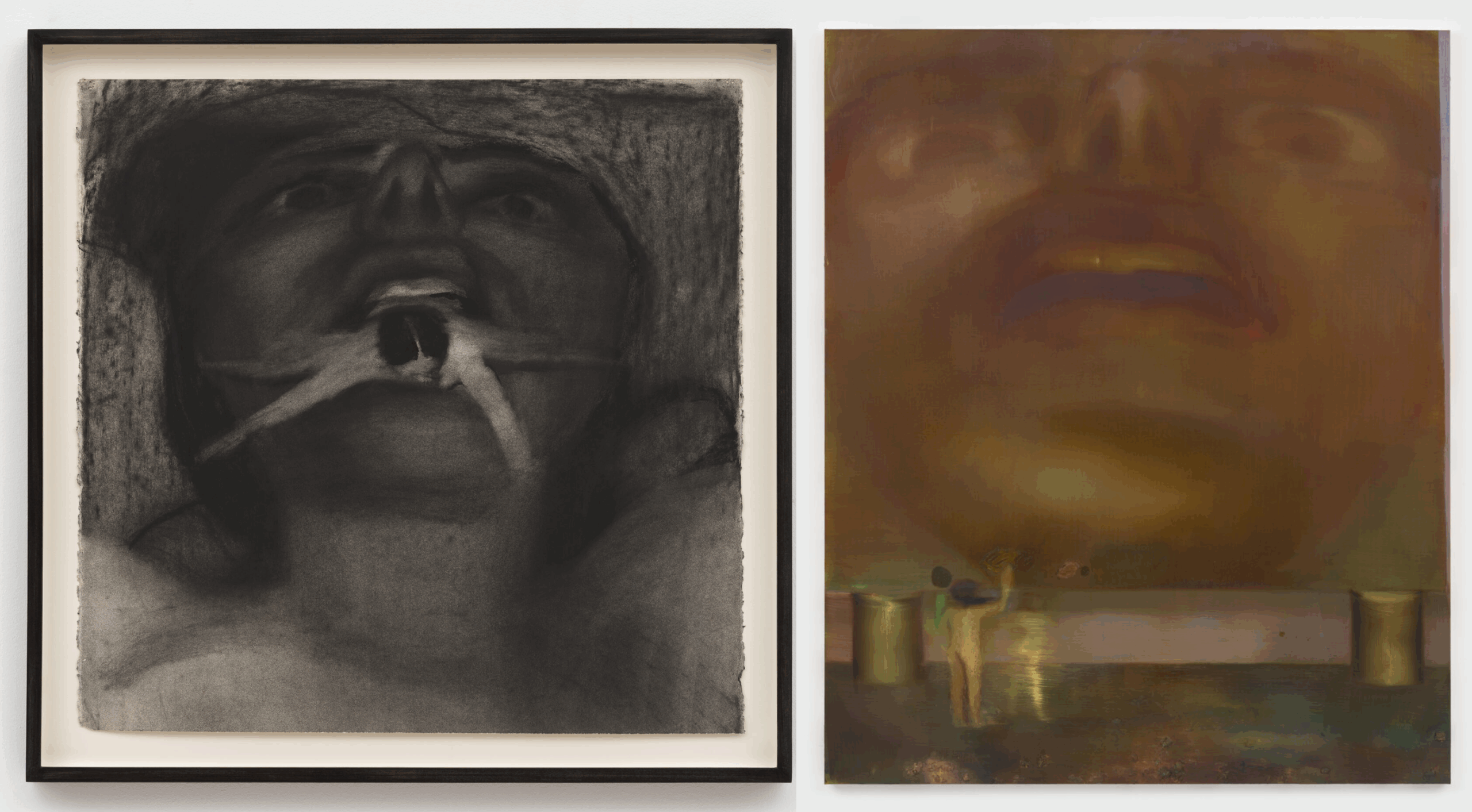
Elizabeth Glaessner, Spirit Rising study, 2025, charcoal on paper (LEFT). Elizabeth Glaessner, Big Head, 2025, oil on linen (RIGHT). © Elizabeth Glaessner. Both images courtesy of Elizabeth Glaessner and P·P·O·W, New York, photograph by JSP Art Photography.
The painting’s meaning evolved as Glaessner worked. While completing the head, she was thinking about fear, violence and control, but also about the oddness of depicting a person painting a giant head in a studio. That tension matters to her process: painting can lead somewhere she didn’t expect, and discovery is part of its pleasure. The image holds onto both registers, so its humor doesn’t cancel its unease. This is more significant than it looks: the painter within the painting turns an otherwise fixed symbol into something being examined and changed.
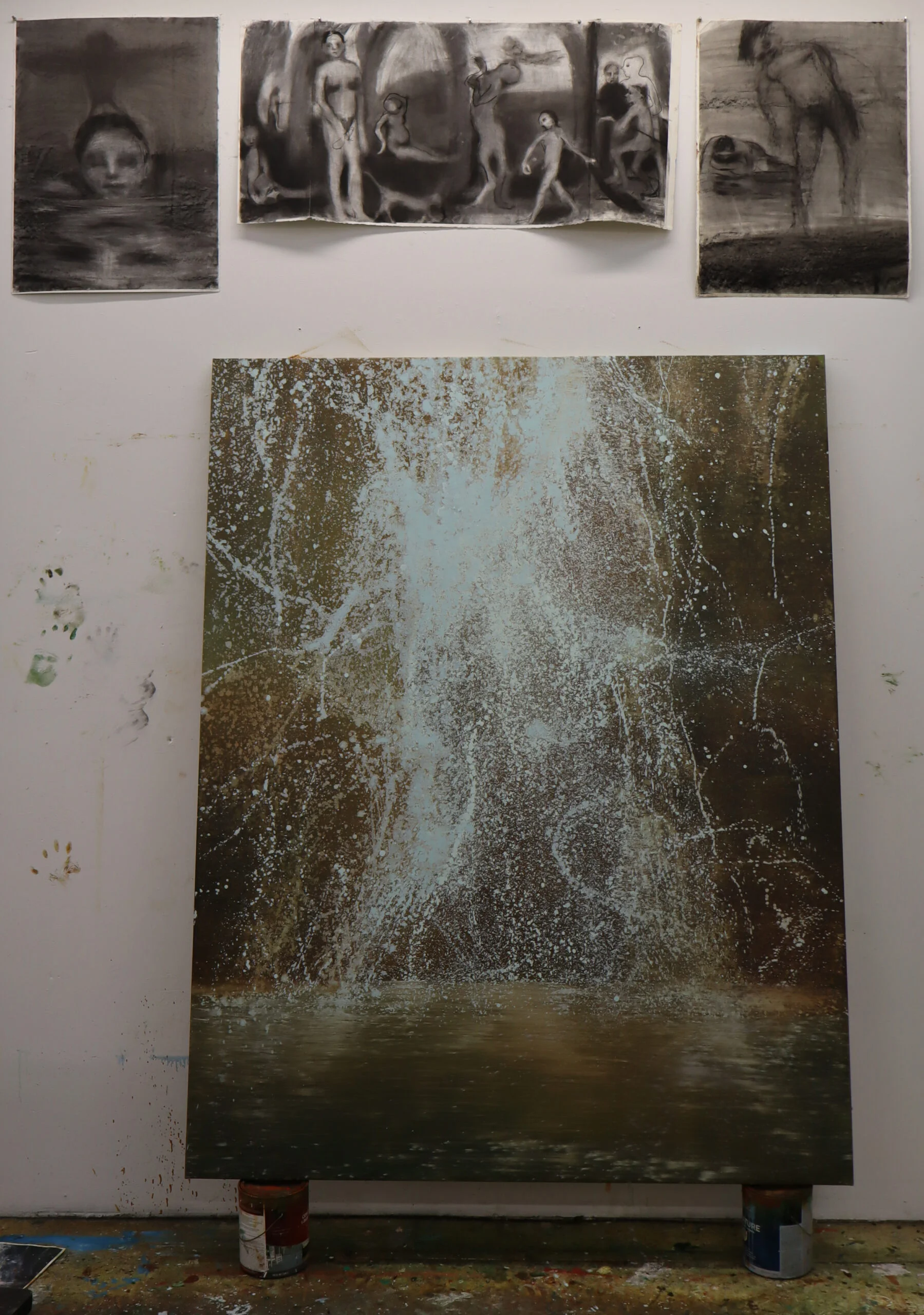
Photograph by Hazel Byers.
Porous bodies and running water
Big Head appeared in an exhibition titled “Running Water,” a name shaped in part by a Daniel Johnston song Glaessner listened to while working. Its lyric asks, “Running water / Where are you running from? / You always seem to be on the run.” She heard in that refrain a sad, beautiful metaphor for constant motion without escape—a feeling that informed the paintings. The title links movement to evasion: water keeps going, but motion alone doesn’t explain what it’s leaving behind or whether it can arrive somewhere else.
The bodies in the exhibition were porous, their outlines stretched or disrupted by their surroundings. Rather than stand apart as self-contained figures, they seemed to leak into the environment, in keeping with the show’s recurring images of expulsion and flow. That visual instability unsettles the usual distinction between a person and the space around them. A body can appear to be changing shape in response to its setting, while the setting in turn seems altered by the body. The images don’t offer a clean boundary to settle the question.
A title that needles the painting
For Glaessner, humor can give an intense image room to breathe. A title can push against a painting’s dominant mood and, in doing so, sharpen it. Big Head lightly teases the scene: a small person painting a huge head, with an implied suggestion of ego. The joke depends on the painting’s imbalance of scale, but it also gives viewers a way into an image shaped by heavier material. The levity doesn’t resolve the work’s emotional tension. It makes that tension easier to approach, and perhaps harder to dismiss.
Music also helps set the terms of her work. Glaessner now listens to it in the studio after spending time with audiobooks and news podcasts. For drawings and small paintings, ambient music gives her space to concentrate. On larger canvases, she chooses music to suit the mood; when an album fits, she may play it on repeat until the work moves on. The distinction suggests that the sounds aren’t simply background: they respond to the scale and demands of the task. And yet the painting has its own pace, which may eventually make a once-useful soundtrack feel finished.
She has recently picked up Osamu Dazai’s No Longer Human, a book she associates with alienation and the feeling of being human without quite feeling it. That question echoes the unsettled figures in her paintings, where bodies and surroundings rarely keep to separate boundaries. The connection doesn’t turn the paintings into illustrations of a book; it gives another point of reference for their estrangement. If you’re working in this space, that distinction matters: influence can shape the questions a work asks without dictating a single answer.
What the work leaves open
Across the painting, exhibition, music and reading, Glaessner’s account points to a practice built around images that don’t settle into one meaning. Fear can become an occasion for reflection; a joke can sit beside violence; a body can blur into its surroundings. The recurring motifs matter because each return gives her a chance to alter the relationship among those elements. The source image persists, but it doesn’t remain untouched.
Here’s the thing: the figure painting the mouth offers a modest kind of agency, not a neat escape from the past. It can look back, remake the scene and still remain within it. Unfinished, in the best sense.
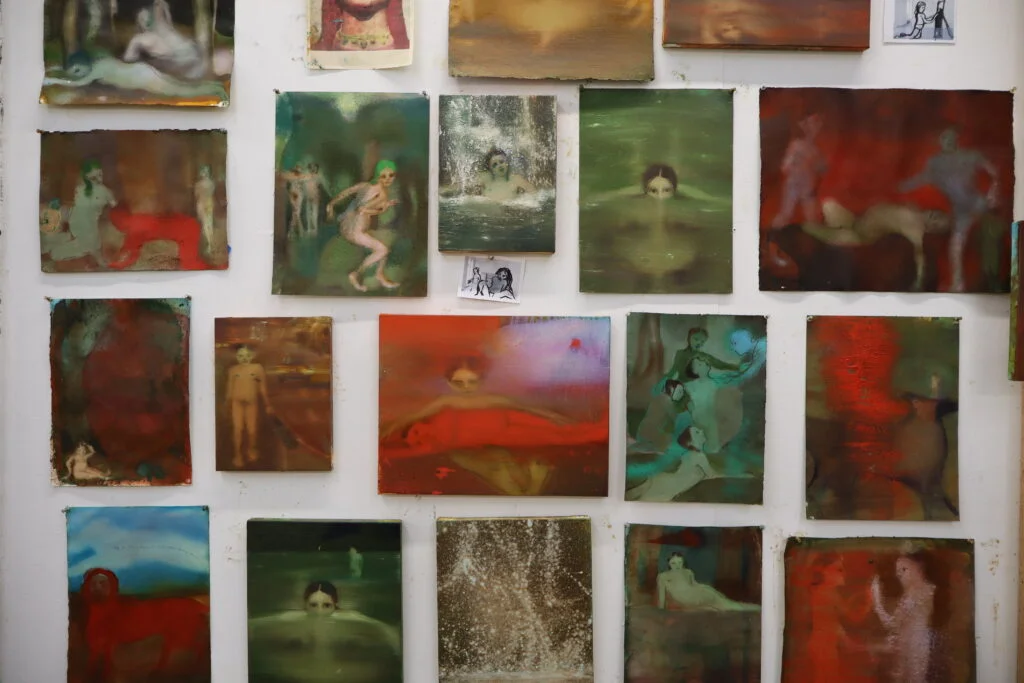
Photograph by Hazel Byers.
Hazel Byers is The Paris Review’s engagement editor. Izzy Casey is the Review’s business and events manager. Elizabeth Glaessner is a visual artist.


