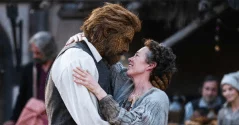
Wicker has an inherently tricky romantic lead: a husband made of woven branches. Early reviews suggest the film’s success rests on making that premise feel intimate, with Olivia Colman and Alexander Skarsgård supplying much of its warmth and appeal. The 105-minute fantasy comedy adapts Ursula Wills-Jones’s 2008 short story “The Wicker Husband,” but critics are divided on whether the feature-length script gives its ideas enough room to breathe.
 95%
 93%
Performances give the fable its emotional center
Colman plays a headstrong woman whose defenses soften in private. Critics point to her ability to hold both sides of the character at once: sharp when facing ridicule, vulnerable when the armor slips. One review says her work lifts the film beyond what its “quirky medieval romp” premise might promise.
Skarsgård faces a different challenge. His character is literally made of wicker, yet reviews describe a performance shaped by expressive eyes, hesitant speech and gentle humor. That combination gives the husband an earnest humanity, turning an easy visual gag into a believable romantic counterpart. The pairing’s attraction, critics say, is part of what keeps the story grounded.
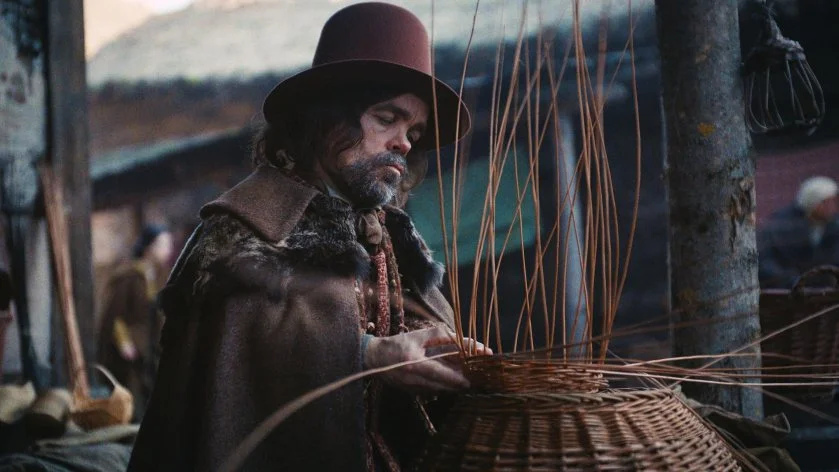
The supporting cast adds a darker comic edge. Elizabeth Debicki draws praise for playing jealousy and cruelty with enough bite to make the film’s darker turns funny as well as unsettling. Peter Dinklage fits the story’s deliberately strange world, while Richard E. Grant earns notice for a brief appearance as the village doctor.
A romantic comedy with a knowingly bawdy streak
The central relationship is the film’s clearest strength in the early response. Critics describe it as tender and fragile, with Colman and Skarsgård lending emotional weight to a love story that could easily have played as a one-note oddity. The film also uses the couple to look at marriage, desire, jealousy and the lines a village draws between outsiders and insiders.
Its sexual humor is deliberately blunt. Reviews say the jokes and innuendo aren’t just there for shock value: the story mines sexual frustration for comic tension and uses it to expose the community’s appetites and resentments. That mix of sensuality, silliness and social observation gives the fantasy a sharper point than its premise suggests.
Comparisons range from The Princess Bride to Edward Scissorhands. The first captures the film’s playful fantasy and romance; the second points to its interest in an artificial being who seems more compassionate than many of the humans around him. Those echoes offer useful reference points, though Wicker leans harder into adult sexual comedy than either film.
The feature length tests the short story premise
The main reservation is pacing. Wills-Jones’s source story runs 14 pages, leaving writer-directors Alex Huston Fischer and Eleanor Wilson to build a feature around a compact idea. Some critics find the added world-building and supporting roles stretch the material; others say the narrative circles back to familiar jokes without developing them, leaving clever lines where a stronger emotional core should be.
There’s a counterargument: one review sees the screenplay’s broader scope as a way to balance comedy with questions about gender and social change. Still, the split response suggests that the expansion is uneven. The chemistry may carry the film through its softer stretches, but the script’s rhythm could determine whether the fable feels charming or overextended.
Practical effects and period design earn notice
The craft appears to be a consistent bright spot. Reviews single out Lol Crawley’s cinematography, Renato Cseh’s production design and period costumes for creating a fairy-tale village with a restrained, storybook look. The score adds a playful note without overwhelming the scenes.
Skarsgård’s woven character is also a showcase for practical effects by Joe Dunckley and WETA Workshop. The detailed face, expressive eyes and beard make the design legible as a character rather than a costume. Andy Neil’s sound work adds creaks that give the figure physical presence and a touch of vulnerability.


