The Best Santoku Knife for Everyday Slicing and Dicing
A santoku can earn its place beside your chef’s knife—or take over its spot on the counter. Its appeal is practical: a compact blade that handles the routine work of chopping vegetables, mincing herbs, slicing onions, and breaking down chicken. We tested more than 30 santoku knives to find options across a range of prices.
That’s a useful distinction for home cooks. Professional kitchens often rely on chef’s knives for their reach and versatility, but most people don’t need the same degree of precision for every task. A santoku’s shorter blade and flatter edge make it an easy everyday choice. It may even replace your current chef’s knife as the blade you reach for first.
Why the santoku works
The santoku emerged in Japan around the 1940s or 1950s. Its name means “three uses” or “three virtues”—terms that variously refer to meat, fish, and vegetables, or to chopping, slicing, and dicing. The blade is typically shorter than a chef’s knife, with a relatively flat edge and a distinctive sheep’s foot point. Its form sits somewhere between a nakiri, a gyuto, and a deba, the sturdy, single-edged Japanese fish cleaver.
There was a burst of interest in the shape in the U.S. in the early 2000s. The case for one now is less about novelty than convenience: its size and shape suit a wide range of kitchen jobs. Here’s the thing: a santoku won’t make every cook more precise, and the name doesn’t settle on one definitive set of “three” virtues. But for everyday prep, versatility is the point.
Our top santoku picks
- Best santoku knife: Kazan Ginsan Nashiji Santoku
- Best santoku with a Western-style handle: MAC Professional Series Santoku
- Santoku upgrade: Misono UX10 Santoku
- Worthy splurge: Kazan Arare by Shibata Santoku
- Best budget santoku: Mac Knife Superior Santoku Knife
- Another affordable option: Misono Molybdenum Stainless Steel Santoku
More on our top picks · How we chose the best santoku knives · Other santokus we liked · Santoku knives we don’t recommend · FAQ
Best santoku knife: Kazan Ginsan Nashiji Santoku
Kazan Ginsan Nashiji Santoku
The Kazan’s appeal is how much control it gives you without feeling delicate. Handmade in Japan, this $180 santoku was the lightest model tested, yet its sturdy spine handled dense sweet potatoes as readily as onions, cheese, potatoes, and sandwiches. The blade arrived razor sharp, slicing paper with ease. Its wa-style handle shifts the balance toward the blade, and that opens up useful grip options: choke up for more force, or use a finer pinch grip for careful dicing. The finish has practical and visual appeal, too. Hammer marks inspired by pear skin help food release from the blade, while the wavy lines show the steel’s tempering. It’s an unusually handsome everyday knife.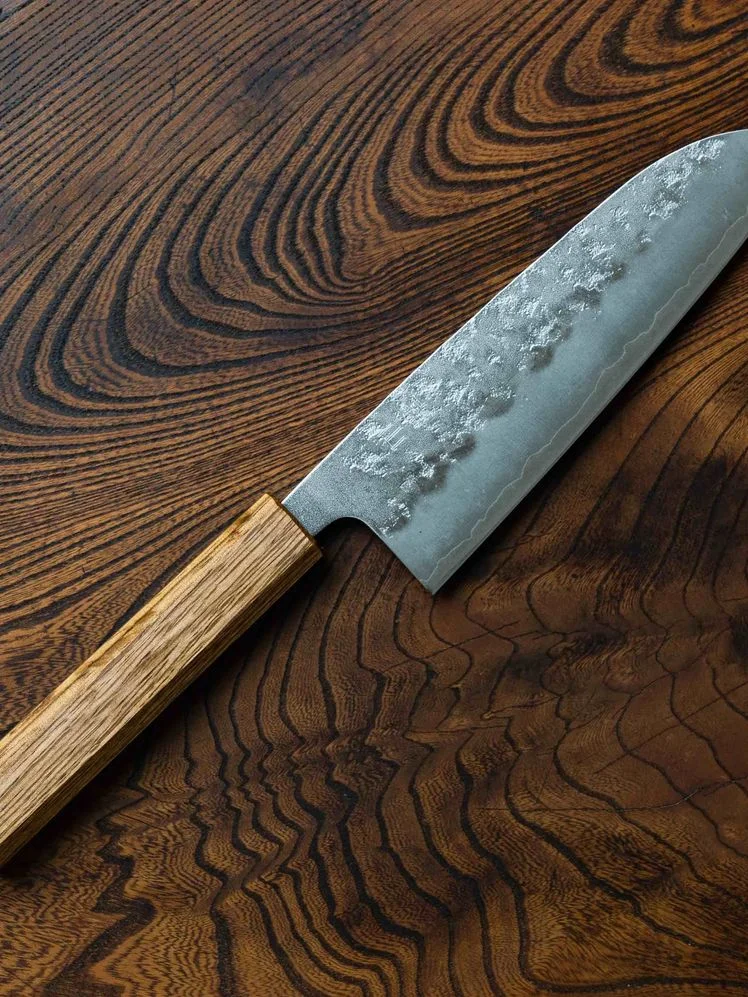 The trade-off is upkeep. Ginsan is stainless steel with high carbon content and good edge retention, but water spots can discolor it if you leave the blade wet. And $180 is a serious price for a santoku. The testers judged its performance worthy of twice that amount, though that’s still a matter of value, not a discount. If you tend to chop and put the knife away without drying it, another pick may suit you better.
- Pros: Razor sharp; nimble but sturdy; attractive hand-finished details
- Con: Expensive
Specs: Weight: 4.5 oz. Blade length: 6.7 inches. Handle length: 5 inches.