This Caribbean Yacht Escape Feels Like Cosplaying as a Tech Billionaire
By Amanda Eyre Ward · October 22, 2026
My week aboard SeaDream I made the case that cruise dining can be more than a buffet with a better view. The yacht’s food is personal, tied to its destinations, and unusually ambitious for a ship this small. That doesn’t make every meal a revelation. But it does make the usual cruise stereotypes feel incomplete.
With Hotels With Great Taste, we’re pulling back the curtain for a peek at the “special sauce” that hotels use to create memorable, meaningful culinary experiences for their guests.
Yes, cruise ships still serve all-night nachos and unlimited soft-serve. Yet some lines are rethinking the food around them: larger ships now host restaurants created and run by Michelin-starred chefs, including Massimiliano Alajmo’s Osteria d’Ovidio aboard Crystal Serenity. The broader shift is toward made-to-order cooking and menus that account for different appetites and dietary needs, from vegan and gluten-free meals to a teenager’s midnight burger.
SeaDream’s plant-based cooking has a longer history than most. Its Norwegian founder, owner, and chairman, Atle Brynestad, hasn’t eaten meat in more than 30 years. In 2011, SeaDream Yacht Club became the first cruise line to create a dedicated plant-based menu. Its two yachts are still the only ships at sea with raw food menus. Brynestad says he has eaten 70 percent raw since visiting the Hippocrates Health Institute in West Palm Beach, Florida. Raw-food devotees say avoiding processed foods and anything heated above 118 degrees leaves them feeling younger and healthier, with clearer minds and more energy. Those are their reported benefits; the account doesn’t establish why they occur.
I expected the raw menu to mean little more than piles of lettuce. Instead, the dishes had vivid flavors and contrasting textures. That difference matters: a plant-based menu can feel like a real culinary point of view, rather than a dietary accommodation.
A yacht at an intimate scale
SeaDream I carries 112 passengers. I boarded in San Juan, Puerto Rico, to teak underfoot, a blue sky, a pianist in the lounge, and a glass of Champagne while I checked in. Over the next week, my teenage son and I visited the British Virgin Islands and St. Barthélemy.
Our 195-square-foot Yacht Club Stateroom had a comfortable queen bed, a sitting area where my son could watch sports, a picture window facing the sea, and a marble bathroom with a multi-jet shower. I missed having a private balcony. The outdoor decks made it easy to find a quiet place anyway.
The ship felt like a private yacht, though we shared it with affluent, well-traveled passengers from the US and Europe. Guests ranged from newlyweds and families with older children to couples in their 50s, 60s, and 70s; some had sailed with SeaDream for decades. My son gravitated to the Golf Simulator. We both enjoyed meeting people at the pool and Top of the Yacht Bar. An elevator serves passengers with disabilities.
One late-night room-service order tested my assumptions more directly than the raw menu did. My son asked for a plant-based “nacho mélange”; I wasn’t convinced. Then a plate arrived with crisp tortilla layers, vegan cheddar, and fresh, vine-ripe tomatoes. In matching navy pajamas embroidered with our names and the SeaDream logo, we polished off the midnight snack.
Menus shaped by the route
The menu follows the itinerary. Mediterranean sailings bring Provençal herbs and black truffles; Croatia brings sea urchin; Caribbean meals make room for coconut, heart of palm, and locally caught fish. One evening I ordered yellowtail ceviche with pink grapefruit. Its bright acidity matched the sunset outside.
Ask for a top-deck table when the weather allows. You can request to eat outside at every meal, and the view—open water, distant island lights, the moon and stars moving overhead—made a stronger case for dinner than any cruise-ship revue could. With no chores or to-do lists, my son and I had time to talk and enjoy the food. I raised him to nineteen; sharing that week with him felt like a gift.
Breakfast had its own small rituals. Within about 30 seconds of our arrival, two lattes appeared in bone china from Porsgrunds Porselænsfabrik, a Norwegian factory that has supplied the royal family for three generations. We ate thin Swedish pancakes with lingonberries. Their Nordic tartness made an improbable kind of sense against the Caribbean beaches.
Meat eaters have plenty to choose from. My son often ordered a five-course dinner built around animal proteins, then followed it with a room-service cheeseburger and a pot of SeaDream’s rhubarb, ginger, and rose tea. I had Asian cashew curry salad, vegetable lasagne made with spinach-leaf “noodles,” and raw avocado Key lime pie.
For our final night, we both chose a fully plant-based dinner. A fresh carrot and green papaya salad and a rice-and-lentil stew arrived as the underwater lights of a neighboring megayacht cast an eerie electric-purple glow.
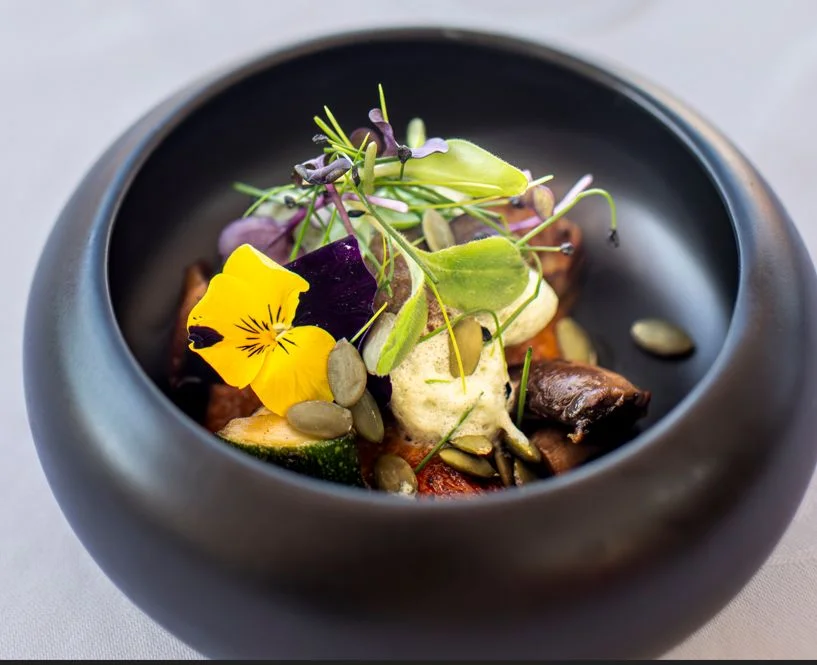
At our top-deck table, rustic eggplant and cauliflower came with basil and tomato coulis. King oyster mushrooms followed, seared until caramelized and served on miso polenta the color of our morning lattes. I expected the chew of a mushroom stem; instead, the knife met a little resistance, then gave way to a silky texture like a well-cooked scallop.
Dessert was a dense chocolate tofu pudding in a rocks glass, covered with fresh raspberries and blackberries. It tasted rich—tech-billionaire rich, if you like—and more elegant than the comparison suggests.

What it takes to keep the menu flexible
For Northern European sailings, SeaDream sources wild mushrooms, berries, and root vegetables from Brynestad’s organic farm outside Oslo. He and his wife, cookbook author Linn Stokke, grow more than 50 kinds of vegetables during Scandinavia’s short summer.
“The galley itself is designed for flexibility,” Brynestad says. “Guests can mix courses from different menus at the same table, so mise en place is prepared daily across all of them, and the signature dishes are always ready to support spontaneous orders.”
That freedom takes serious daily preparation. In a 1,430-square-foot galley, fleet executive chef Tomasz Kozlowski leads 12 cooks who prepare components for four full five-course menus every day. They also maintain rotating French and Mediterranean selections, a fully plant-based menu, and signature dishes available at any time. The operation is small enough to feel personal, but the choice it supports is anything but simple.


