Collectibles
Museum-Grade Triceratops Skull Up for Auction
The fossil leads Joopiter's sale of natural history treasures.

by
Vittoria Benzine
 Share This Article
Fresh on the heels of its first-ever dinosaur auction that raked in $5.5 million this spring, Pharrell Williams‘s online auction platform Joopiter is bringing another Triceratops to market—this time a single skull. The juvenile fossil, named Sofia, is expected to sell for $600,000 to $800,000 on July 1, when bidding closes on “Still Here: An Auction Across Space and Time,” the platforms’s just-opened sale of 24 natural history relics from brilliant minerals to massive megalodon teeth.
From nose to frill, Sofia measures nearly seven feet. An unnamed paleontologist surfaced it five years ago from Marmarth, South Dakota, amid the largely late Cretaceous Hell Creek Formation—which has yielded an Ice Age dire wolf, the Pachycephalosaurus skull that just joined D.C.’s National Museum of Natural History, and another Triceratops fossil that sold for $5.4 million at Phillips last November.
That paleontologist kept Sofia per a “legal fossil lease agreement with the landowner,” the fossil’s provenance states. Excavators at the commercial paleontology company Dinosaurs of America excavated the skull in one go.
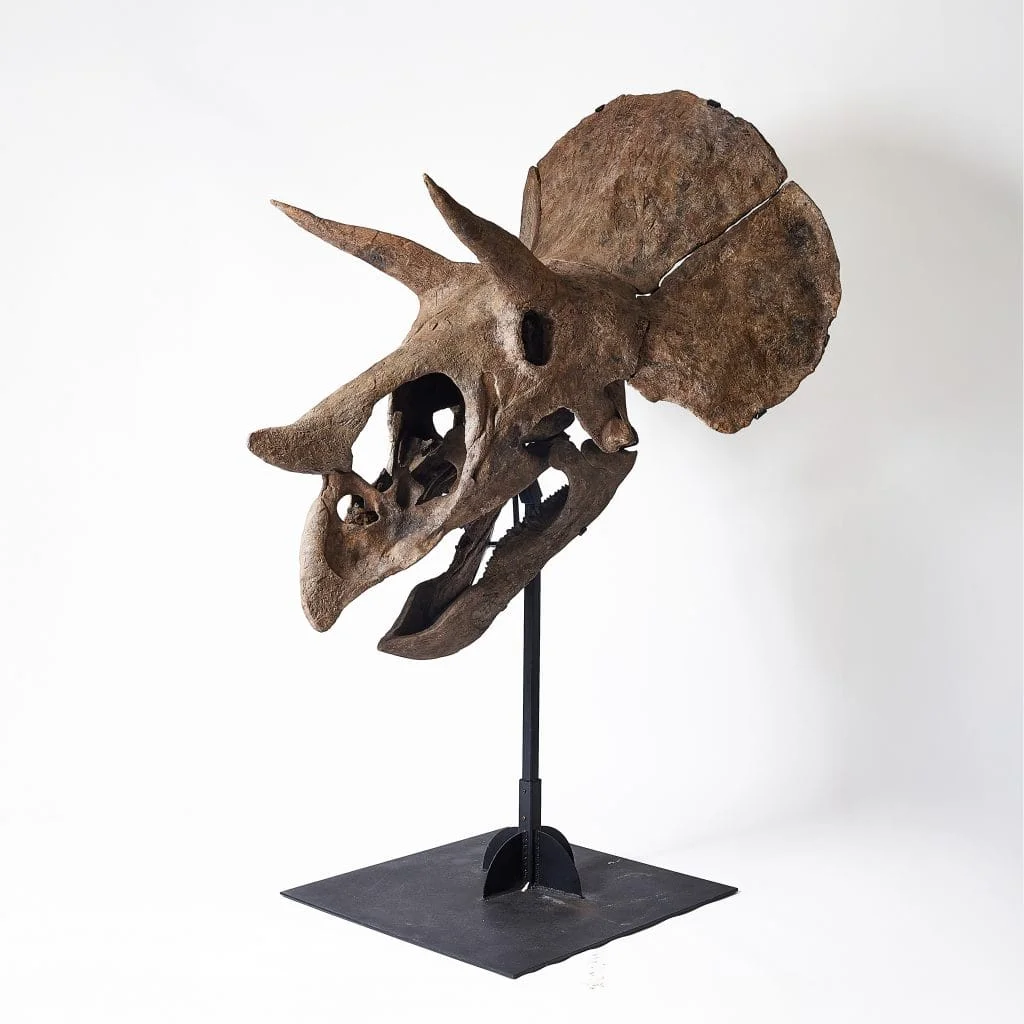
Sofia the Triceratops. Photo: courtesy of Joopiter.
Sofia is classified as museum-grade. Its shade is a less ubiquitous yellow tone, due to the iron-rich minerals that permineralized her. The full fossil is 60 percent complete, which apparently places Sofia in the top ten percent of specimens. The iconic nose horn and brow horns are intact, as are a striking number of teeth. Crucially, Sofia is made entirely from one single dinosaur alone, meaning no outside fossils were used to fill out her missing parts. What’s more, the authentic examples among them are profoundly preserved.
“The disarticulated condition of the skull at discovery contributed to less taphonomic distortion,” Joopiter’s paleontology expert Andre Lujan said. In simpler terms, the skull wasn’t intact, so its individual elements suffered less damage as earth layered atop them, thank to their lower profiles.
Sofia is unpublished, unstudied, and fresh to market. The fossil comes with full title and license, plus unrestricted IP for its assembly. Joopiter is billing the sale as a chance to help shape the story of an otherwise ubiquitous dinosaur. Also noteworthy is the critter’s stand, designed by Zoltan Foltay, who also did the mount for the most expensive dinosaur ever sold.
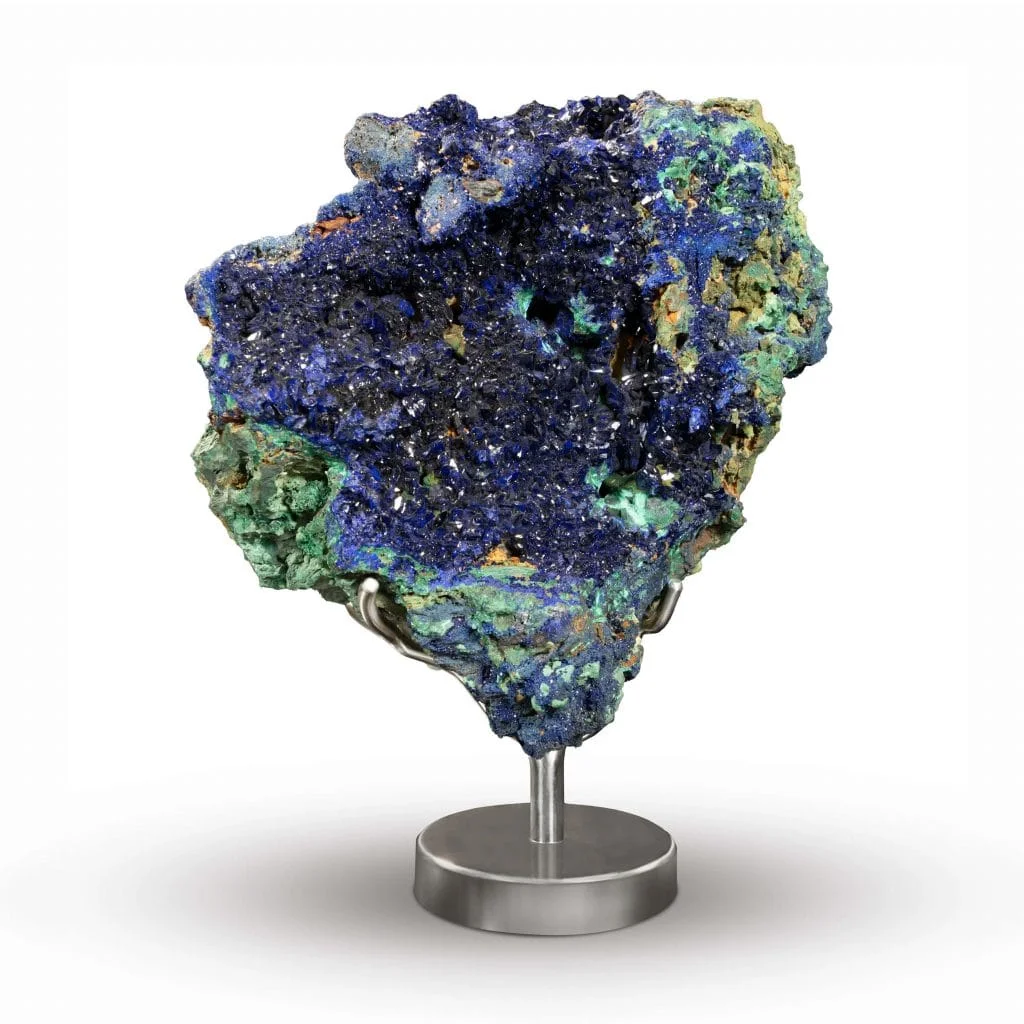
Lot 12: a hunk of Azurite, Malachite, and Limonite from China (est. $40,000 – $50,000) Photo: courtesy of JOOPITER.
With a starting bid of $360,000, Sofia leads “Still Here” by leaps and bounds. The only other lots that barely trail the fossil are three meteors separately hitting block—one from the moon and two from Mars, each with starting bids of $50,000, $60,000, and $100,000, respectively.
Gems still abound beyond—literally, in terms of the juicy Watermelon and Quartz combo expected to sell for $20,000 to $30,000, and metaphorically, in the case of a 1787 engraving from famed astronomer Jean-Dominique Cassini, which bears an estimate of $25,000 to $35,000. Upstarts interested in launching their natural history collections can also start off slower at this auction—there’s an array of fossilized teeth, jaws, and claws on offer too, many priced in the low four figures.