Art Fairs
At Art Basel, Everyone Is Playing It Safe, Eying Market Recovery
Amid lingering uncertainty, a $35 million Picasso sold and a trophy Warhol is on offer.
by
Margaret Carrigan &
Jo Lawson-Tancred
 Share This Article
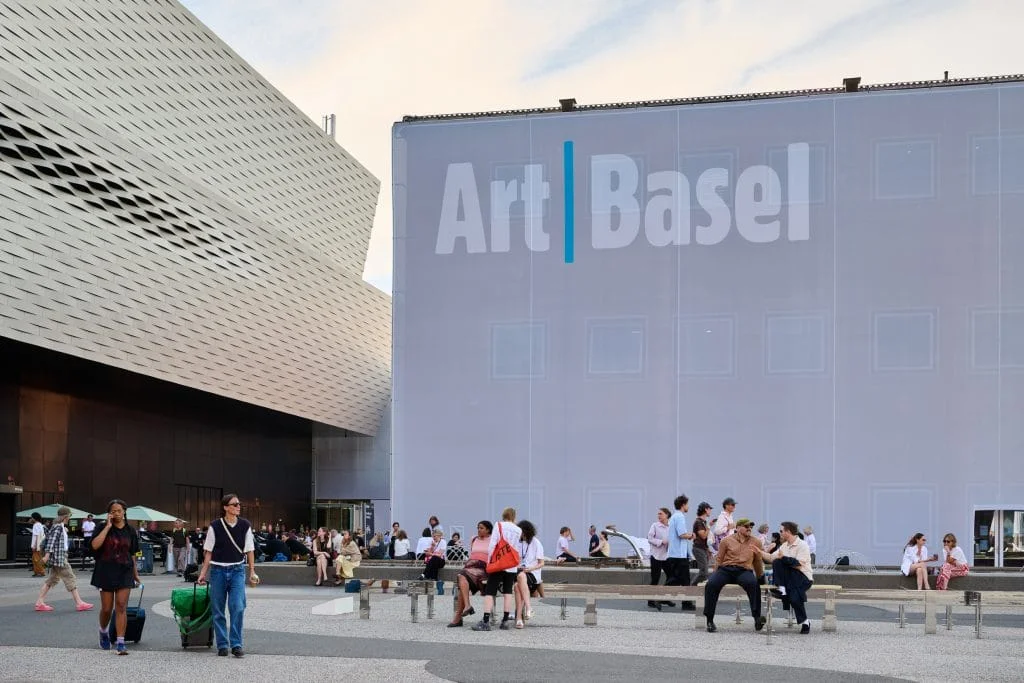
At Art Basel this year, the art trade seems to be finding a new equilibrium. Sales at the invite-only opening of the flagship Swiss fair on Tuesday felt measured and steady, but ebullience remained elusive. Speculative fevers cooled long ago. Many of the 290 exhibitors are being very careful.
One gallery flack said that dealers were “really having to work at the booths.” Hauser & Wirth staffers were certainly working hard. The mega-gallery placed more than $65 million worth of work by the end of the day, including a $35 million Pablo Picasso that he painted en plein air in 1963 of himself and a muse. Iwan Wirth said in a statement that it had been “as strong a first day as we’ve ever had.”
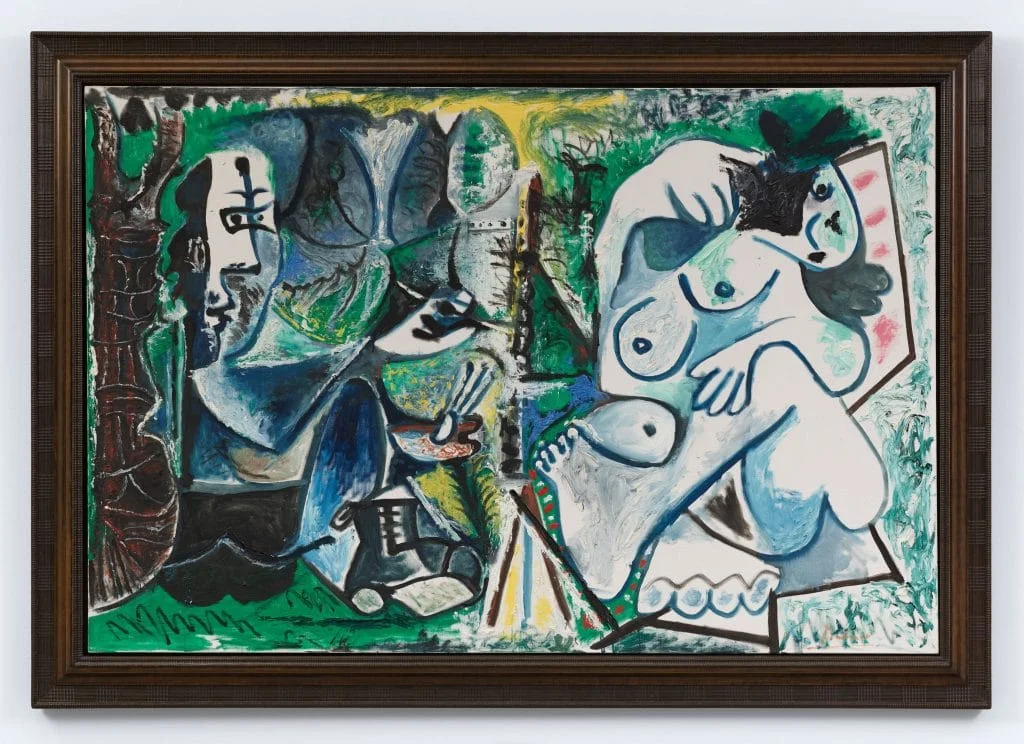
Pablo Picasso, The Painter and His Model in a Landscape, 1963. © Succession Picasso / 2026, ProLitteris, Zurich. Photo: Felix Jungo.
Thaddaeus Ropac cleared nearly $9 million in the first hour, moving a 1952 Pierre Soulages and Helen Frankenthaler’s Sudden Wave (1982), each for around $3 million. Frankenthaler is the subject of a stunning show at the Kunstmuseum Basel: an ideal advertisement.
Around lunchtime, David Zwirner opened WhatsApp to “check how we’re doing.” He scrolled through a long list of sale updates on a group thread. “We’re doing pretty good.” In the fair’s Unlimited sector, where Zwirner has a whopping six presentations, Isa Genzken‘s installation of an airplane’s interior found a home with a European museum for €1.2 million (about $1.3 million). One of two new Victor Man paintings sold for €1 million ($1.1 million), while three works by Josef Albers raked in $2.3 million. All told, Zwirner did more than $10 million in primary market sales. (The gallery did not report prices for its secondary market sales, which numbered in the dozens, it said.)
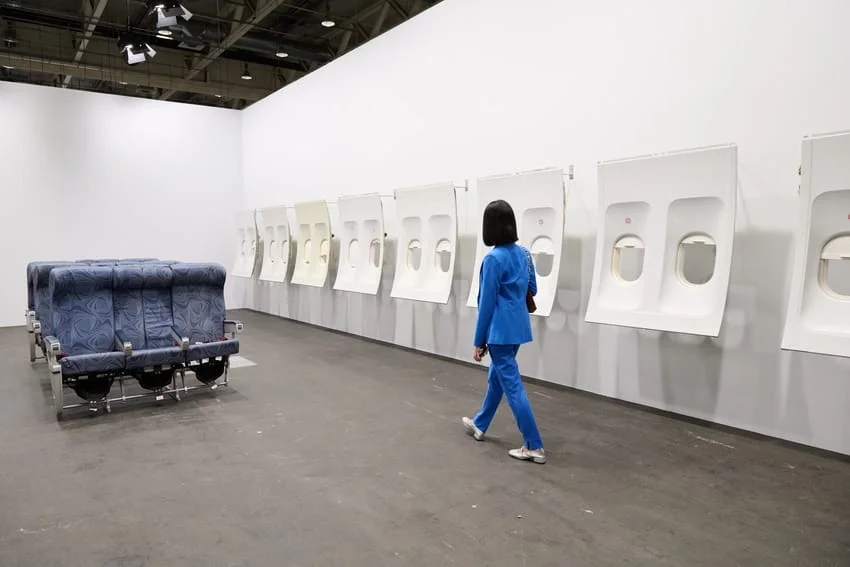
Isa Genzken’s installation at Art Basel Unlimited 2026. Presented by Galerie Buchholz, Hauser & Wirth, David Zwirner. Courtesy of Art Basel.
“Buyers are feeling like it’s safe to say yes to things again,” advisor Benjamin Godsill said. He added that the fair may not be a “feeding frenzy” like it used to be, but works within the $200,000–$2 million range are selling.
Known Quantities
The so-called “flight to quality” continues, as the market finds its footing. London advisor Liberte Nuti spotted a bevy of works from the early 20th century. “You’ve always had your blue-chip Picassos and whatnot at this fair,” Nuti said, “but now there are a lot of historical works.” She pointed to a series of five portraits dated to 1911–16 by the Swiss painter Ferdinand Hodler at the booth of Galerie Haas. They are part of the fair’s new “Basel Exclusive” program, which encourages galleries to hold back works from digital previews so that collectors will be enticed to come to the fair to view them in person. (Broadly speaking, dealers and buyers seem nonplussed about the initiative.)
There were a number of notable works from the late 1980s and 1990s, an era now being thoroughly canonized. Lee Ufan‘s From Wind (1989) at Mennour is priced at €1.5 million ($1.74 million). Michael Werner has a corner devoted to works by the arch conceptualist James Lee Byars from 1989–91. The largest, The Table of Perfect (1989)—a three-ton gilded marble cube that has a companion in the Museum of Modern Art‘s collection—was quoted at around $500,000 (incredibly reasonable by the pound). Meanwhile, Max Hetzler is hawking a 1992/2005 Albert Oehlen “Computer Painting” at €2 million ($2.3 million).
Zero10, the fair’s digital art section, is also sorting out history. It includes a 1997 work by Harold Cohen (1928–2016)—creator of AARON, one of the earliest autonomous systems for artmaking—brought by London’s Gazelli Art House and priced at $400,000. Meanwhile, the local Haus der Elektronischen Künste (House of Electronic Arts) presented a non-selling exhibition that contextualizes Net Art with works created from the 1990s to early 2000s.
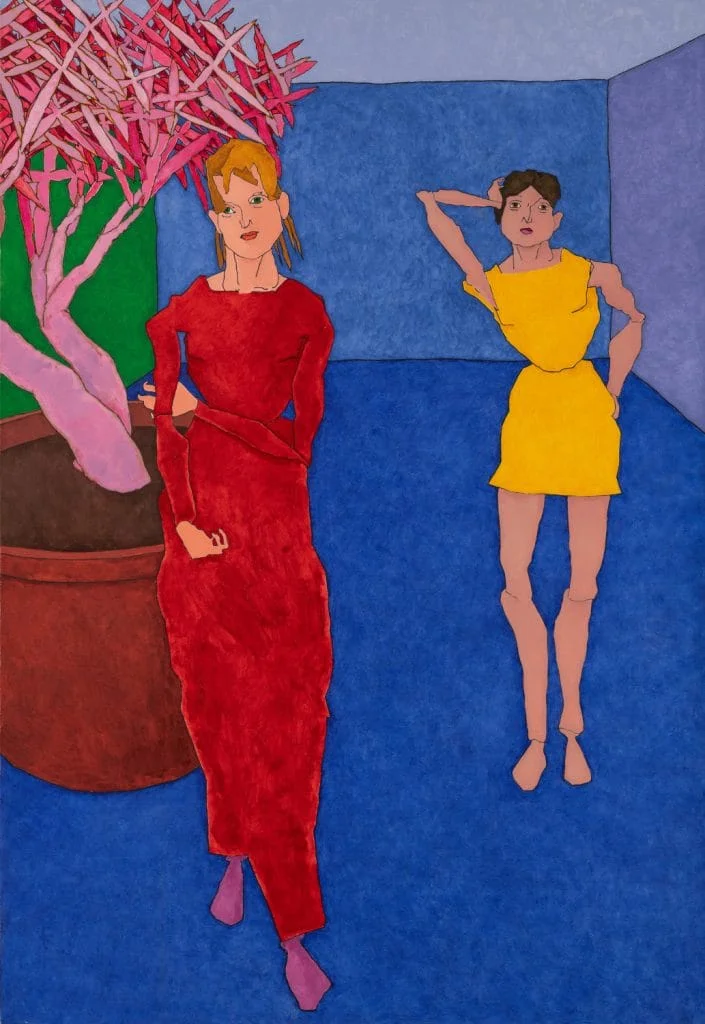
Harold Cohen, Untitled (i23-3391),1997. Courtesy of Gazelli Art House & Harold Cohen Trust.
Andy Warhol‘s Self-Portrait (Fright Wig), from 1986, is priced at $35 million at Acquavella. One with the exact same dimensions and color (white)—presumably the same piece—traded for $24.4 million at Sotheby’s New York in November 2016. (That’s $33.9 million, adjusted for inflation.) The record for a Warhol fright wig was set with a larger, purple example, which netted $32.6 million at the same house way back in 2010, more than doubling its high estimate, according to the Artnet Price Database.
A Venice Boost?
That old saying, “See in Venice, buy in Basel,” remains in force, and these days, Art Basel promotes the connection on its website. Still, a biennale perch is no guarantee of immediate sales.
Hollybush Gardens was tight-lipped about interest in a large painting by Britain’s Venice artist, Lubaina Himid. A sculpture by Italy’s Chiara Camoni, offered by Andrew Kreps for €60,000 ($69,000), had yet to sell by Tuesday afternoon, which was also true of a €100,000 ($116,000) textile by France’s Yto Barrada and a €30,000 ($34,800) piece by Germany’s Sung Tieu, both offered by Sfeir-Semler. A $40,000 stone carving by Saudi Arabia’s Dana Awartani, presented by Lisson, is still available, as is a conceptual postcard piece by Spain’s surprise Venice star, Oriol Villanova, going for €15,000 ($17,400) at Elba Benítez.
Demand seemed stronger for artists in Koyo Kouoh’s main exhibition, “In Minor Keys.” An Alfredo Jaar neon text piece, Culture=Capital (2011), fetched $75,000 at Goodman Gallery. James Cohan, who bet big on Venice this year after four of his artists were selected for Kouoh’s show, is collecting dividends. A shimmering wall hanging by Tuan Andrew Nguyen, kept back for Basel Exclusive, fetched $185,000 within 15 minutes of the fair’s opening. A Yinka Shonibare piece fetched £150,000 ($201,000), a smaller ceramic by Ranti Bam sold for $30,000, and a $150,000 Kennedy Yanko was on reserve by the end of the day.
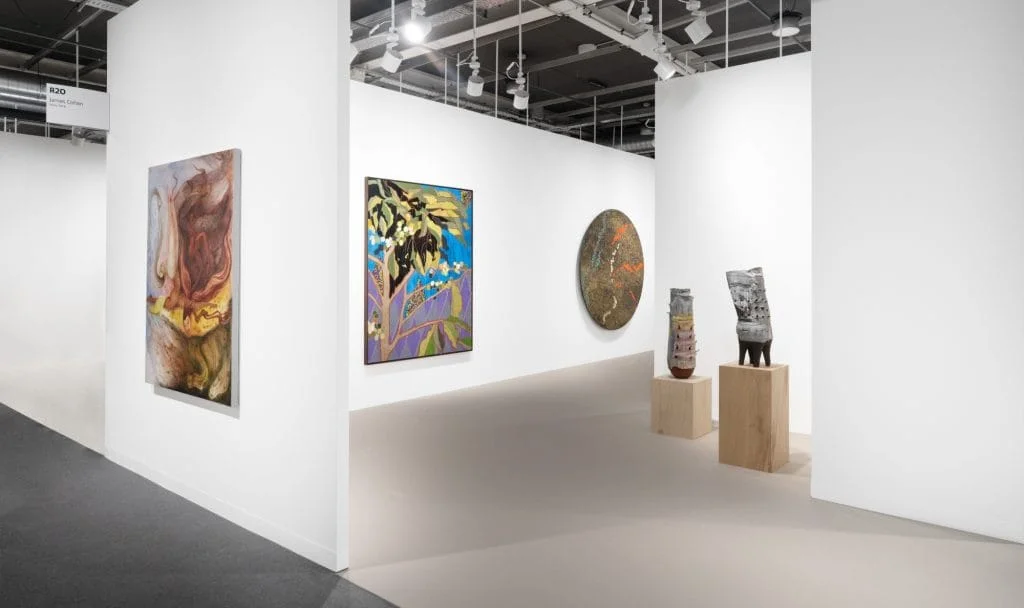
Works by Yinka Shonibare, Tuan Andrew Nguyen, and Ranti Bam at James Cohan’s booth at Art Basel 2026. Courtesy of the gallery.
Attention Seeking
It’s clear that fewer international non-European art types are prioritizing Basel, continuing a post-pandemic trend. Americans and Asians were thinner on the ground, as has been the case for the last few editions, since Art Basel Paris was introduced in 2022. But those who came were “truly happy to be here,” Godsill said.
Among the collector set, New Yorkers Peter and Jill Kraus were present, along with Londoner Poju Zabludowicz and his daughter Tiffany, and Allan and Mei Warburg, owners of the Donum Estate in Sonoma.
The fair also drew a strong contingent of U.S.-based museum directors and curators. Jessica Morgan of the Dia Art Foundation was in attendance, alongside Ann Goldstein, deputy director of the Art Institute of Chicago; Michelle Kuo, chief curator at large of MoMA; and Massimiliano Gioni, artistic director of the New Museum. Scott Rothkopf, director of the Whitney Museum, was there, too, as was his colleague Drew Sawyer, co-curator of the 2026 Whitney Biennial. Cecilia Alemani, director of the High Line and freshly announced curator of the 2027 Taipei Biennial, made an appearance.
Art Basel retains enormous prestige for younger galleries, despite the financial strain of participation. Several in this year’s Statements section hail from nearby German-speaking countries, for whom Basel remains a local portal to the international scene, with many having come up through Liste, the satellite fair next door. The solo presentations in this sector are a breath of fresh air in an otherwise risk-averse edition of the fair.
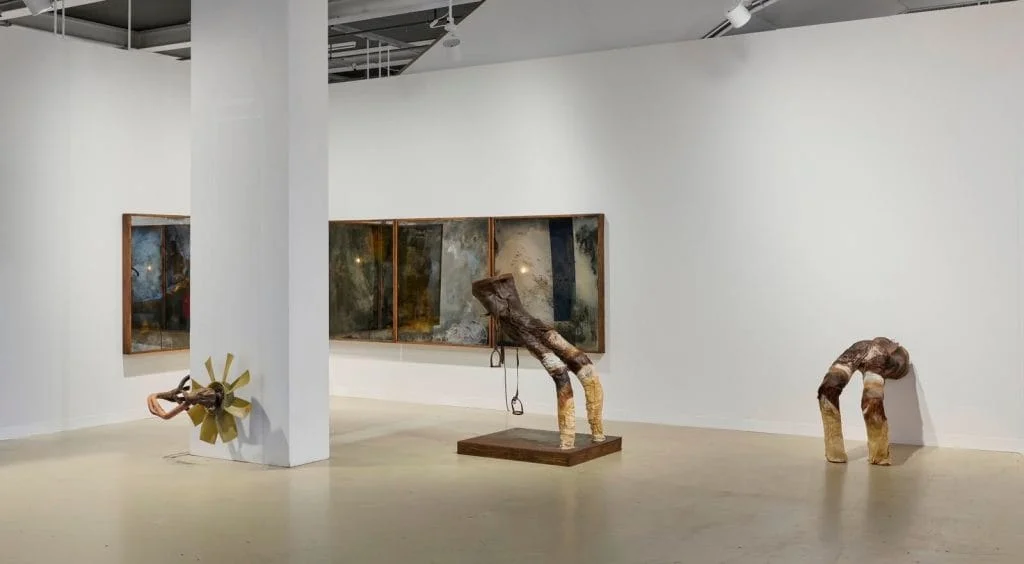
Installation view of work by Monica Mays on Blue Velvet’s booth at Art Basel 2026. Photo: Flavio Karrer.
It must be said that, unlike the Paris, Hong Kong, and Miami Beach fairs, the Basel flagship offers something increasingly rare: a lack of distractions. There is a “concentration of attention” here, said Simon Leibenson, a director at Blue Velvet in Zurich, who showed grubby, bodily works by Mónica Mays in Statements. Nobody left feeling “indifferent,” he said. Most of Mays’s works, priced between CHF 10,000–28,000 ($12,600–$35,300), sold within the opening hours.
At the champagne breakfast early in the day, Art Basel alum Marc Spiegler said that more galleries should be taking risks—mounting what he calls “suicide booths”—in the current market, to grab attention, rather than deferring to what’s expected.
The danger of playing it too safe, of course, is being unmemorable. That may be the tale of this Art Basel.