Gallery Network
How Agostino Bonalumi Turned Painting Into Space
In collaboration with Archivio Bonalumi, the artist's 1970 sculpture returns to view at Art Basel Unlimited.

Artnet Gallery Network
 Share This Article
In 1970, Italian artist Agostino Bonalumi conceived of a monumental, modular sculpture that leveraged the elements of repetition and rhythm to challenge preconceived notions around space, and the viewer’s role within that space and in relation to the work. Struttura modulare bianca was made in preparation for Bonalumi’s solo room at the 35th Venice Biennale, and pointed to a prodigious period in the artist’s career and practice, reflecting a new chapter in his engagement with spatial imperatives and interest in environmental art.
Coinciding with the gallery’s 40th anniversary, Mazzoleni is now set to bring the sculpture to Art Basel Unlimited 2026, introducing the rarely exhibited work to a new audience. Staged in collaboration with Archivio Bonalumi, the presentation of Struttura modulare bianca within the context of the fair’s sector dedicated to museum-scale pieces offers new perspectives on the pivotal work—and its continued significance both historically and today.
Ahead of the presentation’s debut, we reached out to Luigi and Davide Mazzoleni, whose family has a long and storied history with both Bonalumi and the Bonalumi Estate, to learn more about the work’s background and their own insights into the artist’s context and practice.
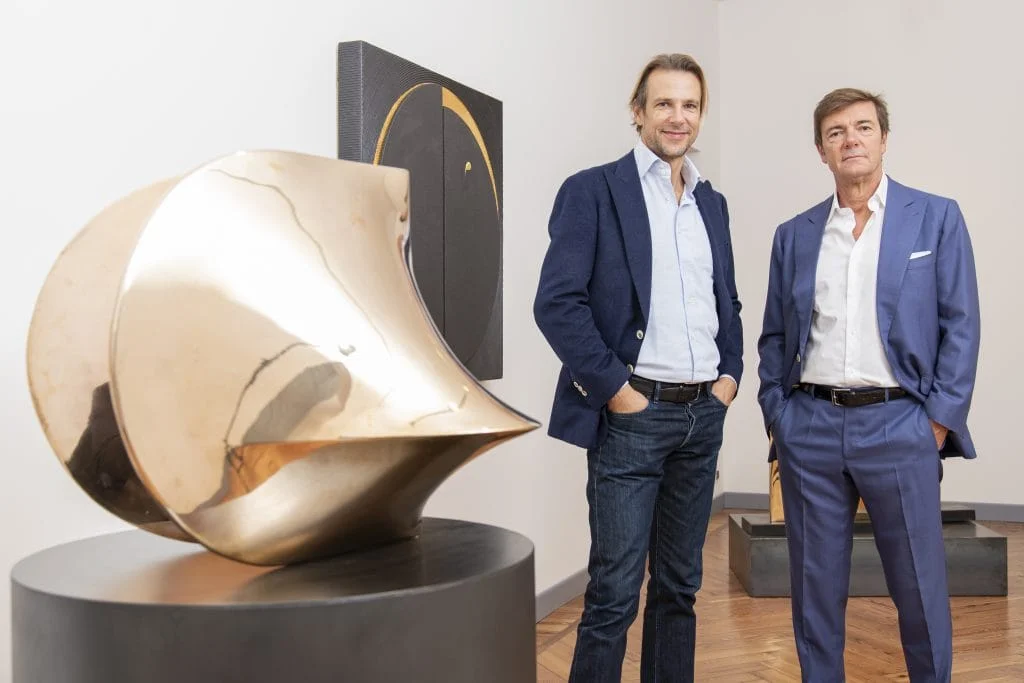
Davide and Luigi Mazzoleni. Courtesy of Mazzoleni.
In light of the upcoming presentation of Bonalumi’s work at Art Basel, can you walk us through the background and significance of Struttura modulare bianca (1970) specifically?
Luigi Mazzoleni (LM): Struttura modulare bianca represents a pivotal moment in the development of Bonalumi’s research toward the “object painting,” as defined by Gillo Dorfles. If we consider that, in one of the earliest presentations of his work at Galleria Eidac in Milan in 1962, Bonalumi staged a performance in which he sculpted a large white sheet with his own body.
It becomes clear that Struttura modulare bianca represents a further development of that line of research and of his intense interest in environmental art. Following the landmark exhibition Lo spazio dell’immagine (Foligno, 1967), where Bonalumi exhibited alongside artists such as Lucio Fontana, Enrico Castellani, Luciano Fabro, Pino Pascali, Michelangelo Pistoletto, and Paolo Scheggi, he developed his first three-dimensional “shaped canvases,” laying the foundations for his lifelong exploration of form, volume, concavity, and convexity. Throughout the 1960s, he refined the concept of the “object painting,” expanding the surface into sculptural and environmental dimensions.
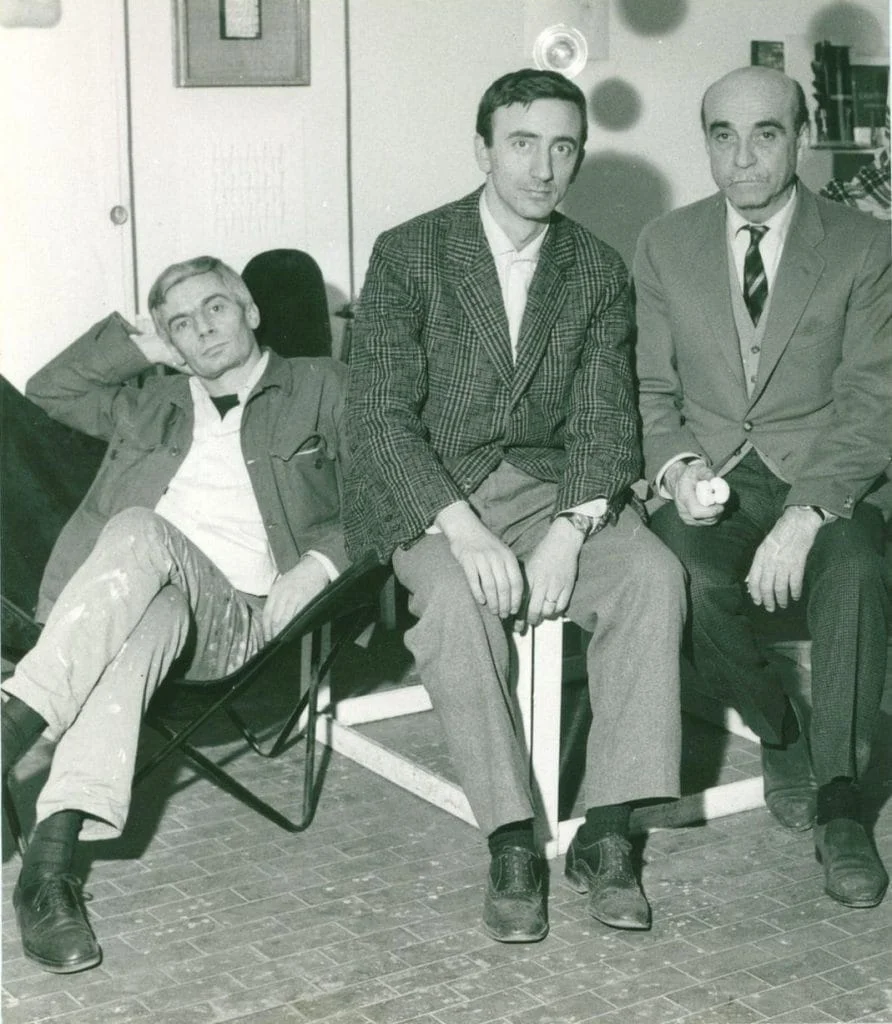
Left to right: Enrico Castellani, Agostino Bonalumi, Lucio Fontana. Courtesy of Archivio Bonalumi.
Do you think presenting the work within the context of Art Basel—or the art fair model more broadly—brings a new dimension to considerations around either this piece or Bonalumi’s practice overall?
Davide Mazzoleni (DM): Bonalumi’s first exhibition with Galleria Mazzoleni dates back to 2008, followed by, among others, a major exhibition dedicated to his sculptural practice in 2014, the inaugural exhibition at the gallery’s Mayfair space in London in 2022, the artist’s solo presentation at Palazzo Reale in Milan in 2018, and the 2025 exhibition dedicated to his dialogue with experimental theater curated by Marco Scotini in Turin.
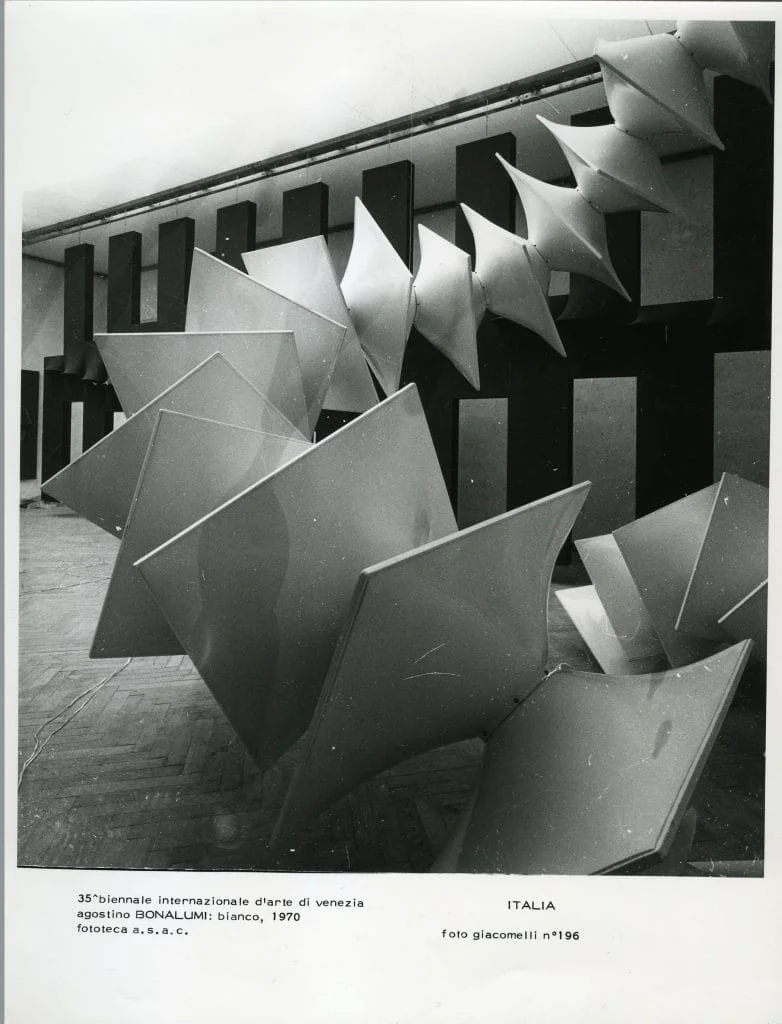
Installation view of Agostino Bonalumi, Struttura modulare bianca (1970), 35th Venice Biennale. Courtesy of Archivio Storico delle Arti Contemporanee.
The presentation at Art Basel Unlimited, where Bonalumi is the only historic Italian artist featured, confirms the sustained recognition of Bonalumi’s research at the highest institutional and collecting level. At the same time, beyond these milestones, it is important to remember the artist’s personal dimension: Bonalumi moved with ease between Milan’s cultural circles and the mechanical workshops where many of his works took shape, combining a rigorous, experimental approach with a deeply personal sensibility, expressed for instance through his poetry and writing.
The significance of presenting Struttura modulare bianca within Art Basel Unlimited lies in the opportunity to observe how it engages with the other works selected by Ruba Katrib, generating a broader spatial and perceptual dialogue.
What do you hope viewers of this presentation take away with them?
LM: Bonalumi transformed the pictorial surface into a true “spatial container,” an organism traversed by invisible forces, tensions, and pressures. His works do not represent space; rather, they generate it, projecting it beyond their own physical limits and into the surrounding environment. Through Struttura modulare bianca, what we hope to convey is precisely this experience: the perception of a restless, living space in constant transformation, which resists any fixed or definitive form and instead unfolds through time and the movement of the gaze.
In this sense, Bonalumi’s most profound legacy is not only formal but also existential: an invitation to perceive the world as a field of energies in tension, while at the same time inhabiting it with attentiveness, lightness, and a quiet, poised intensity.
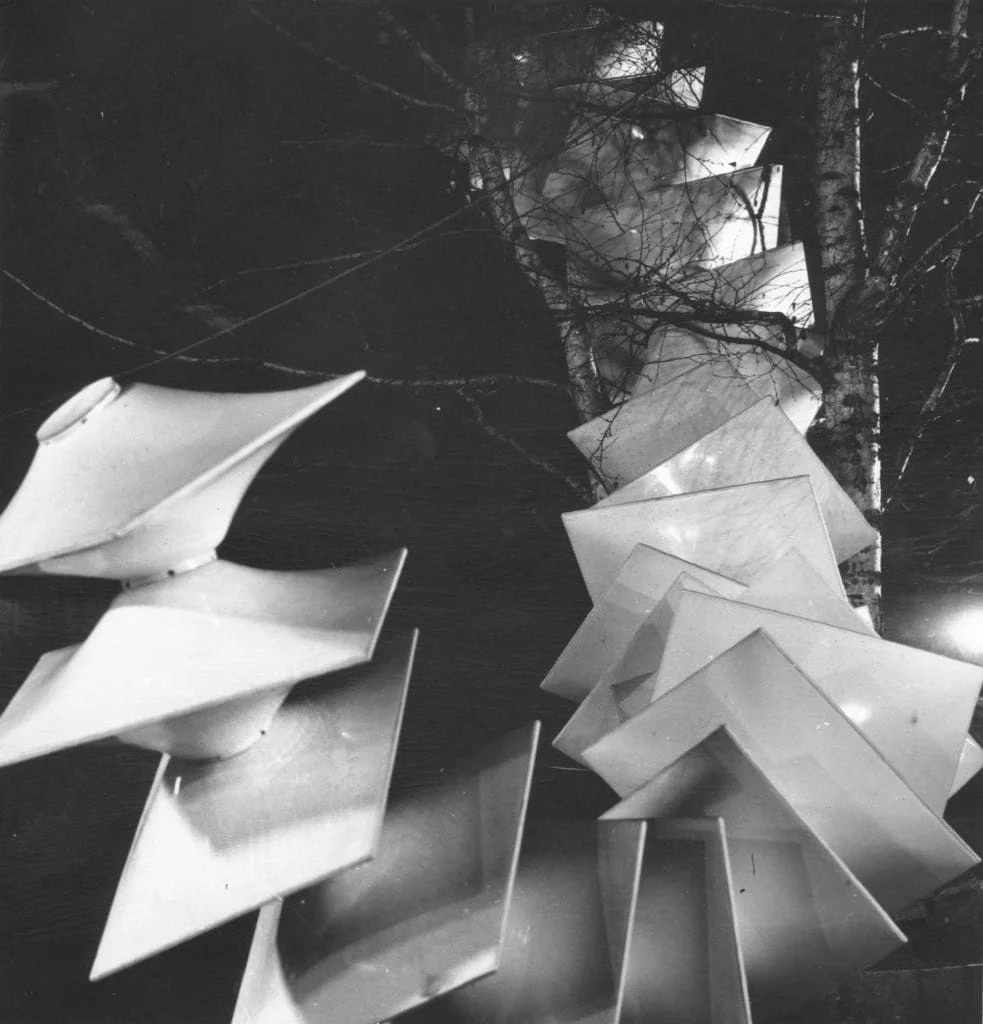
Agostino Bonalumi, Struttura modulare bianca (1970) at the 12th Biennale of Middelheim, Kunsthistorische Musea, Openluchtmuseum Voor, Beeldhouwkunst Middelheim, Anversa (June 17–October 8, 1973). Courtesy of Archivio Bonalumi.
As representatives of the artist’s estate, can you tell us about your and your family’s relationship with the artist and later his estate? When did you first encounter his work?
DM: Our father Giovanni first encountered the work of Bonalumi in 1970, on the occasion of a solo exhibition at Galleria La Bussola in Turin. Together with our mother Anna Pia, by then they had already built a collection reflecting a deep interest in the transformations of post-war Italian artistic culture, particularly in the reductionist and analytical tendencies that would later gain international recognition.
The opportunity to work together arose in 2007, and the personal bond that developed with Agostino, as well as between our family and Bonalumi’s sons, Fabrizio and Pierenrico, gave rise to a profound friendship, grounded in a shared commitment to promoting the artist’s work. Following his passing, this evolved into the management of the Estate, which relies on the important Archivio Bonalumi for all research, preserving with precision the photographic, documentary, and project materials of the artist.
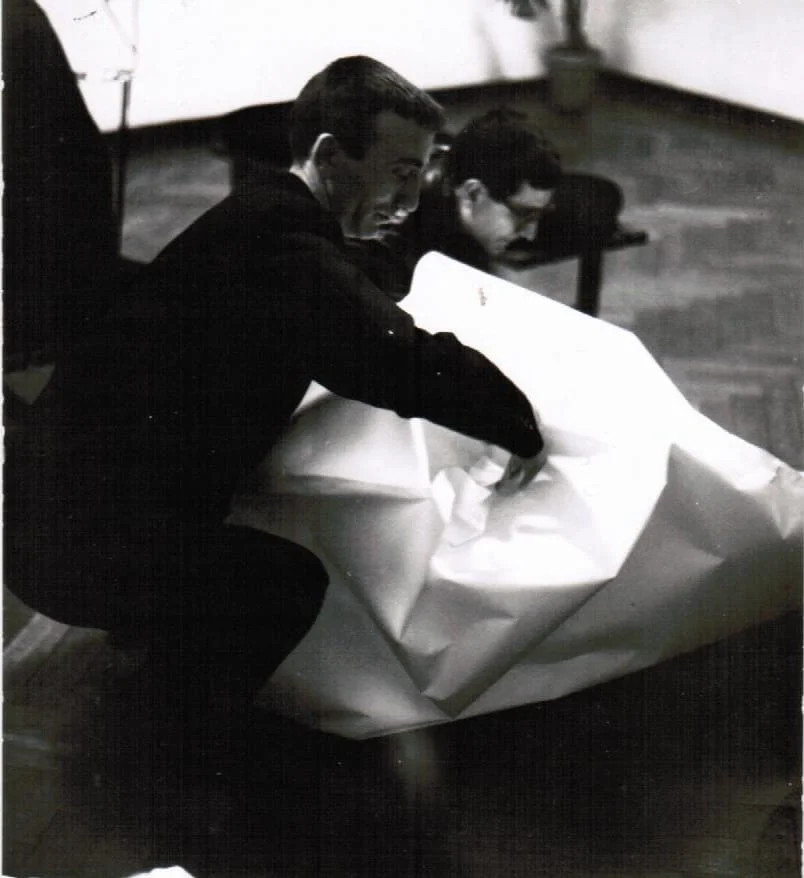
Agostino Bonalumi at Galleria Eidac (1962). Courtesy of Archivio Bonalumi.
First exhibited in 1970 at the Venice Biennale, how do you see the work evolving in significance or interpretation now in 2026?
DM: As Roberto Sanesi noted, “Bonalumi’s space is restless.” It is defined by tension and continuous transformation. In 2026, this sculpture continues to speak to us of the relationship between calm and chaos.
Already in 1966, Germano Celant described Bonalumi’s work as a “spatial vector” projecting towards the viewer, dissolving the boundary between object and environment. That insight remains key today.
In Struttura modulare bianca, the use of white removes expressive distraction, allowing light, shadow and form to take precedence. The work becomes activated through the viewer’s movement, remaining strikingly contemporary as a dynamic spatial experience.
What is something that you’d like audiences to understand about the artist or his overarching practice that might not be widely known?
LM: In Struttura modulare bianca the body of the work is no longer conceived as a passive element but emerges as an autonomous organism capable of expanding into space. Rhythm and order arise from the modular repetition of reliefs which, despite their regularity, generate continuous perceptual variations. The sculpture is conceived to be experienced by the viewer. As Bonalumi himself stated: “I dreamed, through art, of capturing the mysteries of nature’s shadows and then bringing them home and contemplating them.”
Mazzoleni presents Agostino Bonalumi, Struttura modulare bianca (1970) at Art Basel Unlimited 2026.